 Activix
  AutoTrader
  Black Book
  CarGurus
  Equifax
  TransUnion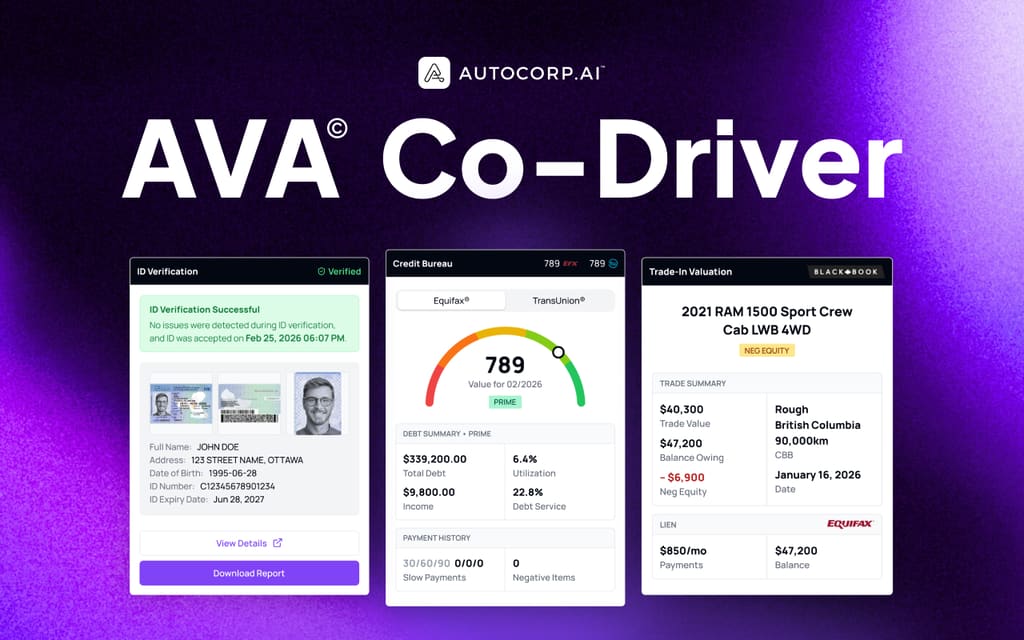



Most F&I managers walk into the box with a name, a stock number, and whatever the salesperson scribbled on the desk log. Then they spend the next 45 minutes catching up — pulling credit, guessing at lender fit, and thumbing through program sheets to find a structure that actually works.
That's the real bottleneck. It's not motivation, product knowledge, or menu skills. It's the fact that your finance manager is doing discovery after the customer has already committed emotionally to a car and a payment.
The dealerships getting the most out of their F&I office in 2026 have flipped that sequence. The finance manager knows the customer's credit tier, income, trade equity position, and the two or three lenders most likely to buy the deal — before the customer ever sits down in the box.
Here's how to set that up.
Key Takeaways
- Give your F&I manager the credit profile, trade position, and buyer signals before the T.O., not during it.
- Replace 30–60 minutes of manual lender sheet comparison with an inventory view that already knows which units each lender will approve.
- Use guided process flows (subprime, newcomer, negative equity) so newer F&I managers work the same playbook a 20-year veteran would.
- Standardize the sales-to-F&I handoff around structured data, not sticky notes.
- Track where deals stall — most of the time it's not the customer, it's missing information at the desk.
Stop Making Your F&I Manager Do Discovery in the Box
Think about how a typical deal reaches finance. Sales works the customer, agrees on a car and a payment, and then walks them back. The F&I manager introduces themselves, asks for a driver's license, pulls credit, and only then finds out the applicant has a 561 beacon, $47K owing on a trade worth $40K, and no lender is going to touch the payment sales promised.
Now the finance manager has three bad options: rewrite the deal (customer feels bait-and-switched), send it back to the desk (sales gets frustrated), or eat the front-end gross to hit the lender's advance. None of those grow the bottom line.
The fix isn't "train the finance manager harder." It's making sure they never walk into a deal cold in the first place.
Load the Credit Profile Before the Handoff
The single biggest lever is putting real credit data in the F&I manager's hands before the customer moves from the desk to the box.
AVA® Credit runs a soft Equifax pull off the website or from any lead form — no impact to the customer's score — and drops the full profile into the lead record. By the time your finance manager opens the file, they can already see:
- Equifax beacon range (e.g., 675–699)
- Total debt and monthly obligations
- Debt utilization (flagged in red when it's above ~80%)
- Monthly income
- Bureau age and thickness of the credit file
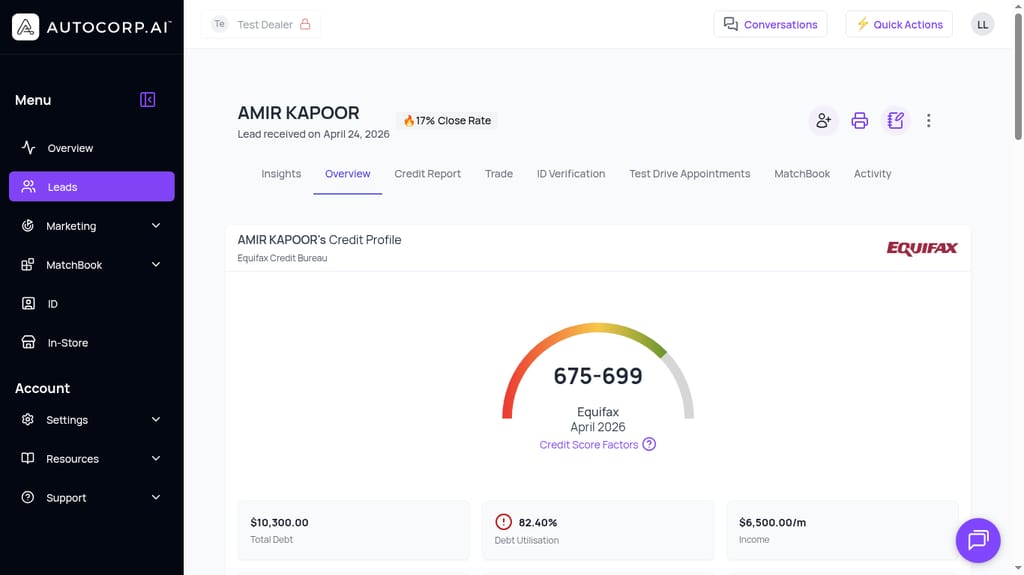
That's not a "nice to have." That's the difference between walking into a T.O. with a plan versus improvising. If income is $6,500 and utilization is at 82%, your finance manager already knows the debt-to-income conversation is coming and can pre-select the two lenders most likely to approve at that ratio.
For leads that haven't shared credit yet, the platform gives you a shareable soft-pull link the customer completes on their phone. It usually comes back in under two minutes.
Give Newer F&I Managers a Veteran's Playbook
Experience in F&I is really just pattern recognition. Veterans know that a 561 beacon with $2,900/month income needs a specific subprime lender, a specific advance ratio, and a specific vehicle price band. Newer managers don't know that yet, so they call around, waste time, and sometimes just kill the deal.
Lead Insights inside the AVA portal codifies that pattern recognition. When a credit profile comes in, the system automatically flags the deal type — Subprime Opportunity, Newcomer Suspected, Negative Equity Detected — and attaches a step-by-step roadmap for closing it.
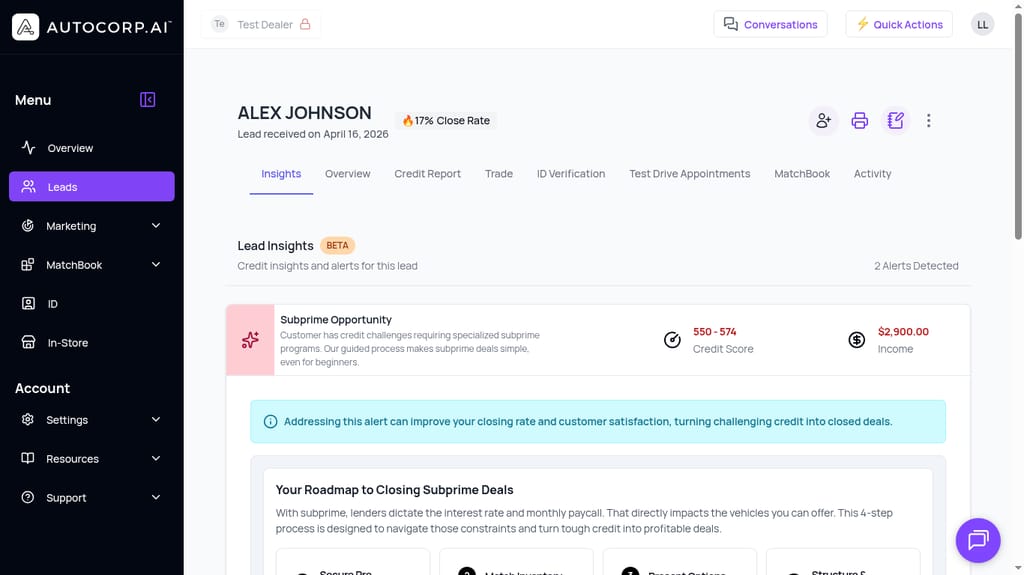
A subprime alert doesn't just say "this is subprime." It tells your F&I manager: secure the pre-approval first, match inventory to what the lender will actually advance on, present the payment/term the paycall supports, then structure the sell. Four steps. Same playbook every time.
The result: a 90-day F&I manager can work a subprime deal with the same structure a 15-year veteran uses. You stop losing tough credit deals just because the person handling them hadn't seen that scenario before.
Kill the 30–60 Minutes of Manual Lender Sheet Comparison
Ask any F&I manager where their time actually goes. A big chunk of it is sitting with three or four lender sheets open, cross-referencing which units in inventory fit which approval, adjusting for advance percentages, then calculating what the payment looks like at each lender's rate and term.
That's an hour, per deal, that produces nothing the customer sees.
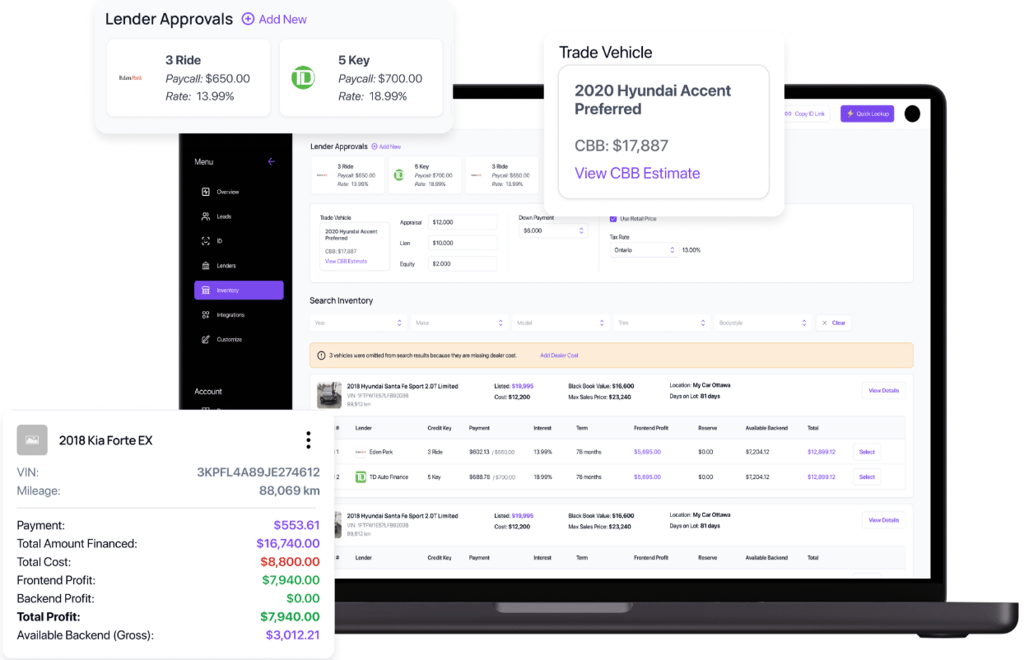
MatchBook eliminates that. It pulls your customer's lender approvals (from Dealertrack or direct) and cross-references them against your live inventory. For every eligible vehicle, it shows the deal already structured:
- The lender and credit key
- Monthly payment at the customer's target
- Interest rate and term
- Cash price with the approval applied
- Frontend profit
- Reserve
- Estimated available backend
AVA® obtiene crédito por consulta blanda y burós completos antes del F&I, para estructurar operaciones que se financian. Haga el recorrido.
Reservar una demo →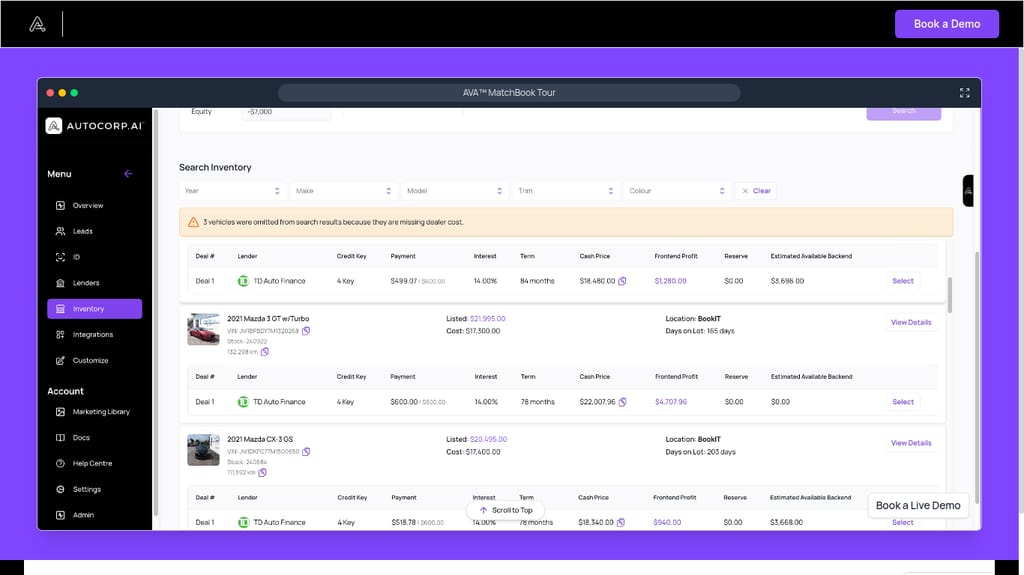
If the customer has $6,900 in negative equity, MatchBook filters for units that can absorb it — meaning your F&I manager isn't fighting the deal, they're picking from a short list of vehicles that already work.
That's how you turn a 90-minute deal into a 30-minute deal without cutting corners on menu or product presentation. See the AVA® Complete plan for how MatchBook and the F&I backend profit calculator are packaged together.
Fix the Sales-to-F&I Handoff With Structured Data, Not Sticky Notes
Most handoff problems aren't communication problems — they're data problems. Sales doesn't skip details because they're lazy. They skip them because the process relies on memory and verbal handoff.
When the customer's credit, trade, and ID are captured on the website or in-store before they hit the desk, that data lives in the lead record. Everyone works from the same file:
- Salesperson sees credit tier and prioritizes the right inventory
- Desk manager sees debt utilization and structures a realistic first pencil
- F&I manager sees the full picture and walks in with a plan
No re-asking the customer their income. No "what did you tell them your budget was?" No surprises in the box. The AVA Co-Driver browser extension surfaces the same data inside Dealertrack, PBS, or whatever desking tool your team already uses, so nobody has to swivel between systems.
For more on what a well-run F&I handoff looks like, our post on best practices for dealer finance managers to reduce risk covers the compliance side in more detail.
Verify Identity Before the Deal, Not at Funding
Compliance-wise, the worst place to find out an ID is fake is at the funding queue. By then you've already delivered the car.
Front-loading ID verification with AVA® ID — driver's license scan, biometric selfie, KYC checks — takes the fraud question off your finance manager's plate. Identity fraud accounts for more than 75% of fraudulent applications in Canada and is up 54% year over year, so this isn't optional anymore. When the ID is verified at the top of the funnel, your F&I manager is signing a real customer, and the funding package clears cleanly.
Reduce Idle Time Between Desk and Box
Every minute a customer waits between agreeing to a deal and sitting with F&I is a minute they use to second-guess themselves. Or worse, look up their trade value on a competitor's site.
When the credit profile is already pulled, the trade equity is already calculated, the ID is already verified, and MatchBook has already surfaced the right unit-lender combinations, the F&I manager can start the meeting the moment the customer walks in. No "give me ten minutes to pull your file." No calling the desk to clarify the pencil.
The wait doesn't disappear — but it shrinks from 20+ minutes to under five, which is roughly the difference between a customer who signs and a customer who leaves to "think about it."
Track Where Deals Actually Stall
The last piece is measurement. If you don't know where your F&I process is bleeding time, you can't fix it. Pull three months of deals and look at:
- Time from lead creation to credit pull
- Time from credit pull to first pencil
- Time from delivery agreement to F&I sit-down
- Time from F&I sit-down to signed contracts
- Deals killed at F&I and why
Nine times out of ten, the biggest gap is between the salesperson agreeing on a deal and the finance manager having enough information to work it. That's the gap Lead Insights and MatchBook are built to close.
What This Looks Like In Practice
A dealership using this setup runs roughly like this: a lead comes in through the website with a soft credit pull and a trade appraisal already attached. The sales team sees the credit tier and pulls the customer toward vehicles in their range. When the customer walks in, ID is verified at check-in via a QR code. The desk pencils a realistic payment using actual debt-to-income numbers. Lead Insights has already flagged that this is, say, a newcomer file, and attached the correct roadmap. MatchBook has already surfaced the three units where the lender approval, the customer's payment target, and dealer gross all line up.
By the time the F&I manager sits down, the deal is essentially built. Their job is to present menu, close product, and get signatures — which is what F&I is actually supposed to be.
That's how a newer finance manager starts hitting the same PVR as your veterans. Not because they suddenly gained ten years of experience, but because the system in front of them holds ten years of experience for them.
Ready to see it work with your inventory and your lenders? Book a demo and we'll walk your F&I team through a live deal.