 Activix
  AutoTrader
  Black Book
  CarGurus
  Equifax
  TransUnion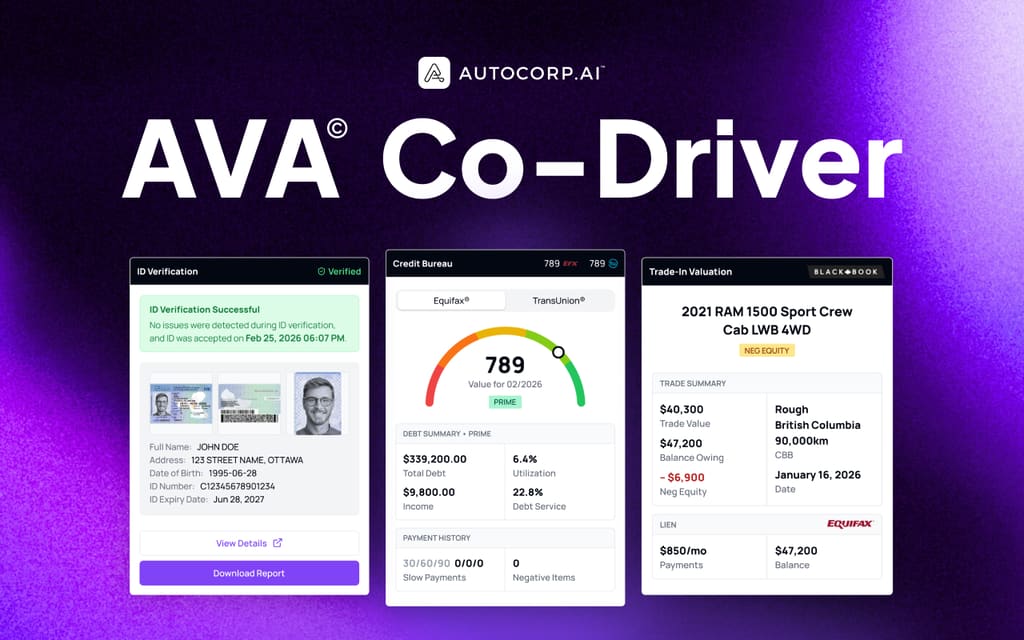



If you run the desk, you already know the moment. The customer was warm on the lot, engaged on the walk-around, laughing on the test drive. Then the numbers hit the table and the temperature drops ten degrees. Arms cross. Eyes narrow. And you get the sentence every sales manager has heard a thousand times: "We just want to think about it."
That sentence isn't about price. It's about surprise.
Customers don't fear numbers. They fear surprises. Late-revealed rates, payment jumps they didn't see coming, trade values that shift, lender conditions that appear out of nowhere. Every one of those "reveals" turns the close from a collaboration into a confrontation. Old-school closing tactics ("If I can get you this payment, will you buy today?") make it worse, because the customer hears one thing: I'm being sold.
In our experience working with dealerships across Canada, there are four things a sales manager needs to fix closing friction for good. This post walks through each one, and how Autocorp.ai's AVA® platform is built to support the M.A.S.T. Transparent Close from the first click to the final signature.
First, What Is the M.A.S.T. Transparent Close?
Before we get into the four fixes, it's worth defining the framework this whole post is built around, because most sales managers we talk to have heard the phrase but never seen it broken down cleanly.
M.A.S.T. stands for Manage, Align, Structure, Transition. It's a closing methodology built on a simple premise: by the time the customer sits at the desk, every meaningful number, condition, and expectation has already been discussed. The close isn't a reveal. It's a review.
Here's what each letter actually does on the sales floor:
M is for Manage the Frame. The close opens with a script, not a pitch: "Nothing here should be a surprise. This is just us reviewing what already makes sense." That single sentence tells the customer they're not walking into a negotiation ambush, and it tells the rep to slow down and lead with clarity.
A is for Align on the Full Picture. Never lead with payment, trade, or rate in isolation. Always show vehicle + trade + structure + outcome together. Customers fixate on a single number when they only see a single number. Show them the whole deal and payment becomes one lever among four, not the only thing on the table.
S is for Structure the Logic (and Present Two Options). Narrate the reasoning, not the arithmetic. Customers don't need to see the math. They need to hear why the numbers fit their situation. Then present two clean options, typically a payment-focused path and an equity-focused path, so the customer has a real choice instead of a take-it-or-leave-it.
T is for Transition with a Confirmation Question. Replace the closing question ("Are you ready to buy?") with a confirmation question: "Which option makes the most sense based on what we discussed?" That reframes the moment from a decision-under-pressure into a natural next step. The customer confirms what's already been aligned on, they don't commit to something new.
The whole framework rests on one idea: nothing in the close should be new. If it's new, it's late. Every letter of M.A.S.T. is designed to push discovery, qualification, and structure earlier in the deal, so the final conversation is confirmation, not persuasion.
That's the language layer. The rest of this post is about how to actually operationalize it, and why the data layer underneath matters just as much as the words.
The Four Things Sales Managers Need to Fix End-of-Deal Friction
1. A Close That Is a Review, Not a Reveal
If the customer learns something new at the desk, it's already too late. The signature symptom of distrust isn't "I don't trust this." It's "we want to think about it," and that phrase almost always traces back to a hidden reality: a rate that wasn't discussed earlier, a term the customer didn't expect, a stipulation that came out of nowhere.
To fix this, you need a repeatable framework where nothing in the close is new. That means qualifying credit, trade, and identity before the customer sits down at the desk, and building the close around the script: "Nothing here should be a surprise. This is just us reviewing what already makes sense."
2. Numbers That Are Explained, Not Defended
Defensive language ("this is the best we can do," "the banks are tight right now," "we're losing money on this") signals to the customer that the numbers are negotiable pressure points, not a structure that fits their situation. That's when payment fixation kicks in and every other lever disappears.
From our experience working with sales managers who lift close rate without lifting gross concessions, buyers remember how the numbers were explained more than what the numbers actually were. A good closing process should give your team the language and the data context to narrate the logic behind vehicle + trade + structure + outcome. Customers don't need arithmetic. They need reasoning.
3. Two Clean Options, Not an Ultimatum
Old-school "commit now" tactics create resistance because they remove the customer's sense of control. But what if the customer is walking in cold, or worse, sitting in a subprime scenario with negative equity where every option looks like a trap?
Most desks handle this by defending a single payment and re-working it three times until the customer walks. A good closing system should let you present two realistic paths, typically payment vs equity, so the confirmation question becomes: "Which option makes the most sense based on what we discussed?" That's a decision the customer feels they made, not one they feel was made for them.
4. A Data Layer That Removes Late-Stage Surprises Before They Happen
Yes, this post is about the close. But the close is downstream of everything that happened before it. A good closing system should also connect to the earlier stages of the deal, credit qualification, inventory matching, and identity verification, so the desk isn't the first place the customer learns their real buying power.
Why? Because every surprise you push earlier in the funnel is a surprise you don't have to defend at the desk. You may wonder, can't our existing DMS or desking tool handle this? It can desk the deal. It can't tell you whether the customer is credit-qualified, matched to a lender-approved unit, and verified for identity before they sit down. That's what closes the gap between "I think we've got a deal" and "we want to think about it."
After years working with dealer principals, GSMs, and F&I managers who were tired of watching hot leads stall at the last table, we built AVA® (the credit-first dealership platform) to support all four of the factors above. What follows is how AVA® makes the M.A.S.T. Transparent Close executable across your sales floor, not just a script on a whiteboard.
Feature Section 1: Make the Close a Review by Qualifying Buyers Before They Arrive
Credit-Qualified Leads (CQLs) Powered by Equifax Soft-Pull, So Nothing at the Desk Is New
The first Step in the M.A.S.T. framework is Reset the Frame. But you can't reset a frame that was never set. If your team's first real conversation about credit happens at the desk, the customer is walking into a reveal, not a review.
AVA® Credit is a website-embedded credit application that pulls a soft Equifax credit file, no impact to the shopper's score, and returns a real credit range, buying power, and lead insights before the salesperson ever picks up the phone. That means the "Reset the Frame" script ("nothing here should be a surprise") is actually true, because the customer already saw a range, already engaged with structure, and already knows this dealership operates in the open.
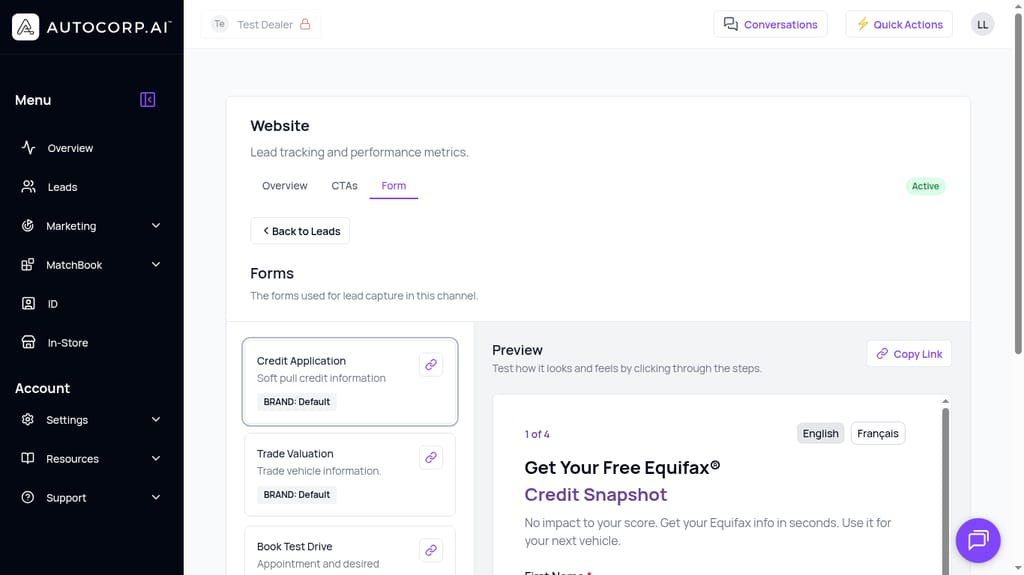
For example, say a shopper submits the credit form on your website at 9pm on a Tuesday. By the time your BDC calls Wednesday morning, the lead is already tagged in the AVA® Leads dashboard with a credit tier (Prime, Newcomer, Subprime), a score range, and flags like Negative Equity or 17% Close Rate. Your team walks into the follow-up call knowing what the customer can actually afford, and the customer walks in knowing they've already been treated like a serious buyer.
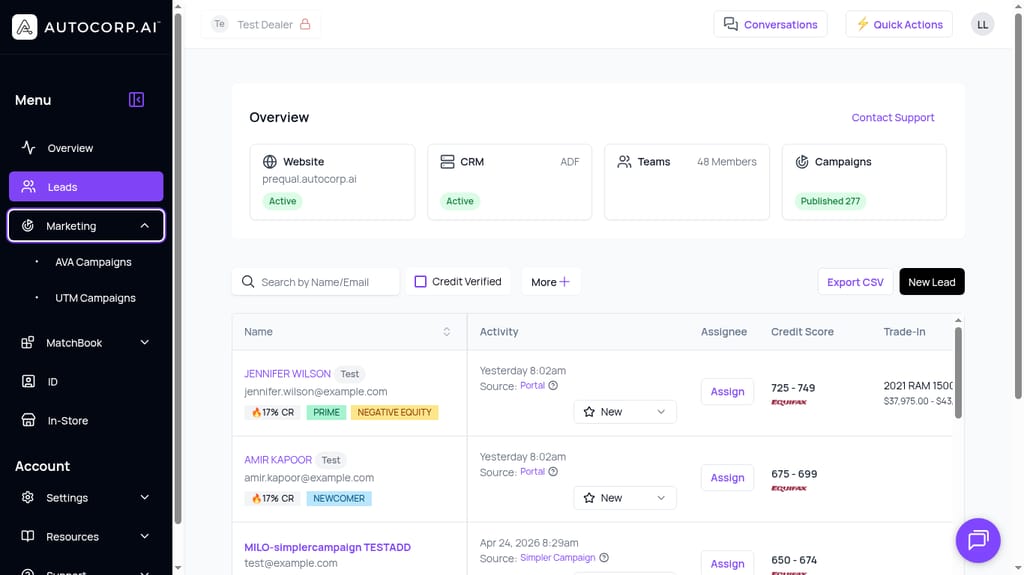
That's simple. But what about the harder case, the walk-in who never touched your website?
For walk-ins, the goal per the M.A.S.T. framework is to "slow the emotion, not the process." Calm data, no hype, no apology. AVA® Credit runs the same soft-pull in-store on a tablet, so within 90 seconds the desk has the same buying-power picture that a web lead would have. You skip the guess-and-defend routine and go straight to "here's what we're working with, and here's how it fits together."
This is a significant shift for the desk in terms of (1) fewer late-stage payment surprises, because the score range and buying power were established up front, and (2) less negotiation drag, because the customer isn't reacting to numbers, they're reviewing them.
For many sales managers, if a customer walks in and asks "what can I actually afford here?", the honest answer is "hang on, we'll pull credit and get back to you." Twenty minutes later, the customer is on their phone and half-checked-out.
With AVA®, credit qualification happens in seconds, not twenty minutes. That's the difference between a customer who feels informed and a customer who feels processed.
Feature Section 2: Present the Full Picture, Not a Single Number (Vehicle + Trade + Structure + Outcome)
AVA® MatchBook Ties Inventory to Lender Approvals So Every Option Is Real
Every desk manager we've worked with has run into the same problem: a customer fixates on payment, the sales team defends payment, and the deal collapses because payment was never the real issue. It was structure.
AVA® revela crédito por consulta blanda, valor de intercambio e identidad verificada en cada prospecto. Haga el recorrido.
Reservar una demo →From our experience, when sales managers stop leading with a single number and start leading with the full picture, close rate lifts without a single point of concession. What buyers actually want is to see, in one view:
- What vehicle are we talking about, with real cost and real days on lot?
- What lender is going to fund this, and at what rate and term?
- What does my trade do to the structure, and if I'm upside down, how does that get absorbed?
AVA® MatchBook answers those three questions in a single screen. It takes your customer's lender approvals (pulled directly from Dealertrack) and matches them against your live inventory, showing you which units the customer is actually approved to drive home, with payment, rate, term, frontend profit, and estimated backend already calculated per lender per unit.
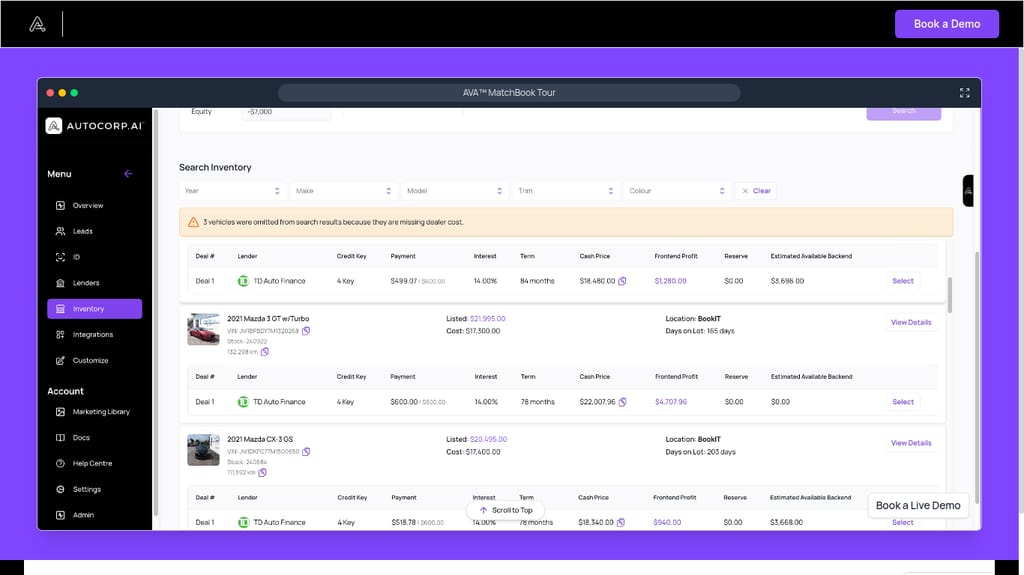
You can pull a MatchBook view in a couple of clicks and it auto-updates as lender approvals come in. So instead of the salesperson walking to the desk and asking "can we do this?", the answer is already on the screen.
Where MatchBook Really Earns Its Keep: Subprime and Negative Equity
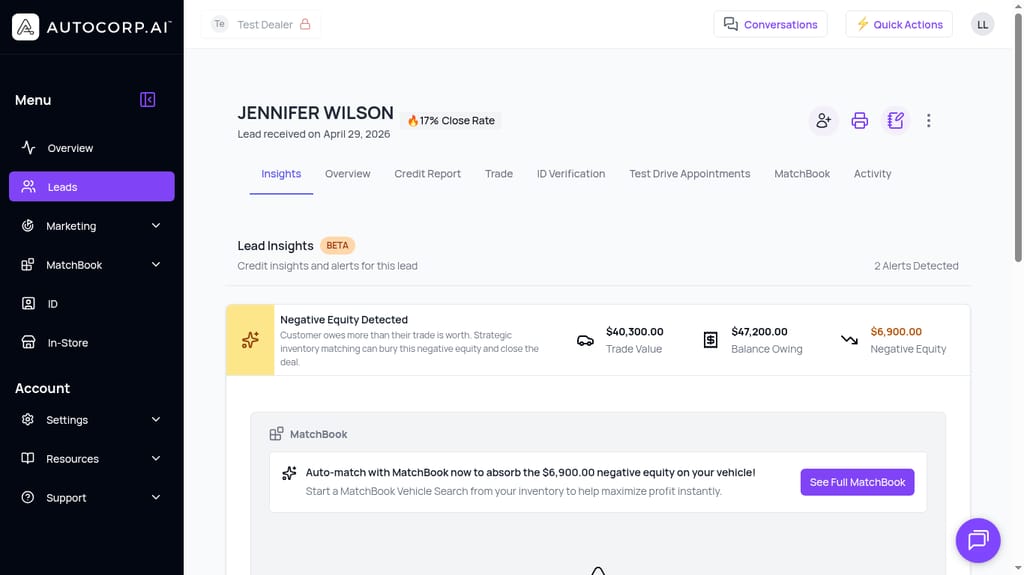
Subprime and negative equity are where surprises live. Customer thinks they can trade the truck they owe $47,200 on for something similar. Trade appraises at $40,300. That's $6,900 of negative equity nobody has mentioned yet. If your team reveals that at the desk, you've just handed the customer a reason to say "we want to think about it."
AVA®'s Lead Insights flags this the moment trade and payoff data are in the system, and prompts the salesperson to auto-match with MatchBook to find inventory that can absorb the $6,900 gap without blowing up the payment.
The same logic applies to subprime. When AVA® detects a credit score in the 550-574 range with limited income, it doesn't just flag the challenge, it opens a Roadmap to Closing Subprime Deals that walks the salesperson through securing pre-approval, matching inventory the lender will actually fund, presenting realistic options, and structuring the deal to profit. That's the "Present Options, Not Ultimatums" step of M.A.S.T., built directly into the workflow.
This is a serious change from how most desks operate. Most teams present one deal, defend it, then re-work it if the customer pushes back. With MatchBook and Lead Insights, you can present two clean options side by side (say, a longer term at a lower payment vs a shorter term that builds equity faster) and let the customer confirm which one fits. That's the confirmation question of the M.A.S.T. framework: not "are you ready to buy?" but "which option makes the most sense based on what we discussed?"
The customer stops hearing "I'm being sold" and starts hearing "I'm in control."
Feature Section 3: Remove Last-Minute Eligibility and Fraud Surprises (All Inside AVA®)
Integrated ID Verification So the Desk Doesn't Become the Fraud Check
From our experience, most sales managers are comfortable with the credit and structure side of the close. Where it falls apart is the last 20 minutes: verifying who the customer actually is, whether their license is real, and whether the file is going to fund.
Identity fraud accounts for over 75% of fraudulent applications in Canada and has risen 54% year-over-year. That means a growing number of your "closed" deals are quietly at risk of being rewound after the customer drives off. And when your F&I team catches the mismatch late, it either kills the deal at the desk (surprise, meet friction) or costs you a chargeback weeks later.
AVA® ID handles this before it becomes a desk problem. It's a biometric, driver's-license, and credit-bureau verification flow that the customer can complete from their phone, either from the pre-qualification portal or from a link your team texts them.
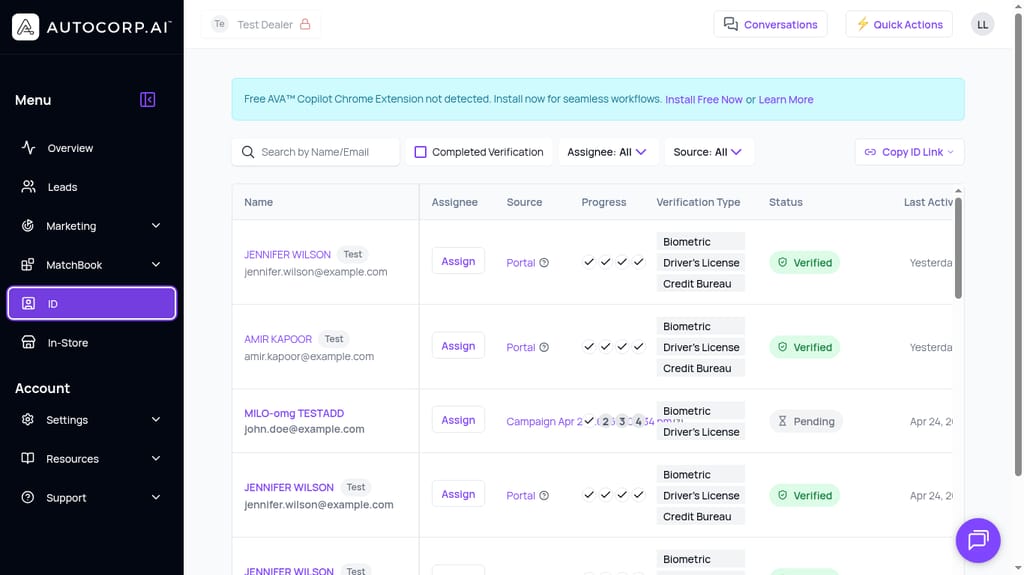
The way it works is simple: the customer submits a photo of their government ID, does a liveness selfie, and the system automatically parses the ID, cross-checks it against the credit bureau file, and returns a verified/pending status with a downloadable, lender-ready report.
For example, say a lead comes in from your website and books an appointment for Saturday. Before Saturday, they've already completed ID verification from home. Your salesperson walks into the meeting knowing the customer is who they say they are, and the F&I office knows the file will fund. The "final review" at the desk stays a final review, not a fraud investigation.
This matters most for appointments, which per the M.A.S.T. framework should feel fast, clean, professional. Higher-intent buyers have less patience for games and delays. If your close is interrupted so someone can go photocopy a driver's license and eyeball it against a face, you've just injected the exact kind of process friction the appointment was supposed to avoid.
Another example: test drives. A significant share of vehicle theft happens through fraudulent test drives with fake or stolen IDs. AVA® ID gates the test drive booking with the same verification, so your team spends time driving real buyers instead of running plates on strangers.
Both flows can be triggered from the same portal, and every result rolls up to the lead record, so the desk manager can see, at a glance, whether every gate has been cleared before the customer sits down.
Feature Section 4: Standardize the Language of the Close Across Every Rep (Without Rebuilding Your Tech Stack)
A Manager-Enforced Close Framework, Backed by Data Every Rep Can See
Yes, this post is about closing friction. But a real answer has to work on Monday morning across every desk and every rep, not just when your best closer is on shift.
A common objection we hear from sales managers is: "We already have desking software. We need people to actually execute." That's fair. The problem isn't that reps don't know how to close. It's that they don't have a shared language, and they don't have shared data.
Why does that matter? Because the difference between "collaboration → confrontation" and "collaboration → confirmation" often comes down to which words leave the rep's mouth in the last five minutes of the deal.Why does that matter? Because the difference between "collaboration to confrontation" and "collaboration to confirmation" often comes down to which words leave the rep's mouth in the last five minutes of the deal.
The Word Track That Actually Moves Close Rate
Compare these two:
- Old way: "If I can get you this payment, will you buy today?" → customer hears "I'm being sold."
- The customer hears "I'm being sold."
- M.A.S.T. way: "Based on everything we've already aligned on, this option fits cleanly. Which of these two paths makes the most sense to you?" → customer hears "I'm in control."
- The customer hears "I'm in control."
Same customer. Same deal. Different outcome. The second version only works if the rep actually has "everything we've already aligned on" in front of them, credit, trade, structure, inventory match, ID status, all in one place.
That's the layer AVA® adds on top of your existing DMS and desking software. Every lead record surfaces:
- Credit tier and buying power (Equifax soft-pull)
- Trade value and equity position
- Matched inventory with lender-approved payment/term/rate
- ID verification status
- Lead Insights alerts (negative equity, subprime opportunity, etc.)
- Credit tier and buying power (Equifax soft-pull)
- Trade value and equity position
- Matched inventory with lender-approved payment/term/rate
- ID verification status
- Lead Insights alerts (negative equity, subprime opportunity, etc.)
You may wonder, can't the rep just pull all this from three different tools? Yes, but that's exactly the problem. Every context-switch is a chance to lose the customer's attention, and every gap between systems is a chance for a number to shift between screens. That's where the "surprise" enters the deal.
With AVA®, the desk manager can enforce a standard: no close proceeds until credit is qualified, inventory is matched to an approval, and ID is verified. When those three lights are green, the rep opens the deal with the "Reset the Frame" script, presents the full picture, narrates the logic, presents two options, and asks the confirmation question. Every time. Every rep.
A confident close doesn't convince. It confirms.
And when you connect the AVA® data layer to the M.A.S.T. language layer, that confirmation becomes the default outcome, not the lucky one.
Bring the M.A.S.T. Transparent Close to Your Sales Floor
If your team is losing deals to "we want to think about it," the fix isn't more pressure or a better payment. It's fewer surprises, earlier.
AVA® is how Canadian dealerships turn the close into a review: credit qualified up front, inventory matched to real approvals, identity verified before the desk, and the whole picture visible to the rep in one screen.
Book a demo with an AVA® specialist to see how the platform maps to the M.A.S.T. Transparent Close on your specific store's workflow. Or explore the Ultimate Car Sales Playbook to share the framework with your team before your next Monday morning meeting.