 Activix
  AutoTrader
  Black Book
  CarGurus
  Equifax
  TransUnion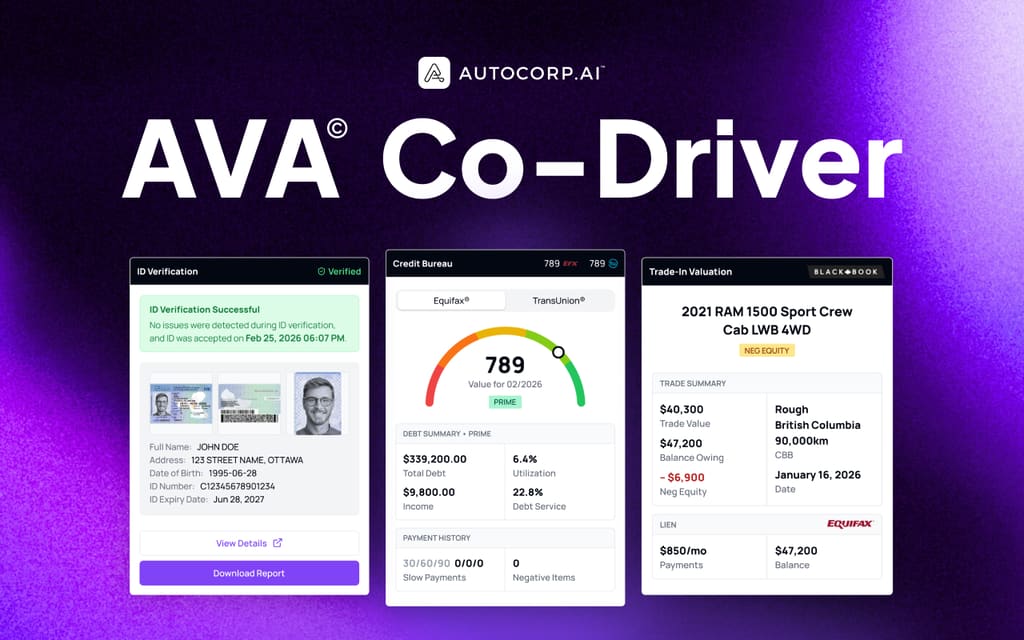



The gap between a used unit that turns in 25 days and one that sits for 90+ isn't usually the vehicle. It's the pricing decision that was made the day it hit the lot — and how often that decision gets revisited.
Canadian Black Book is the data source most Canadian dealers already trust for that decision. But there's a difference between pulling a Black Book number and running a pricing process around it. The stores that consistently turn inventory faster have built the second one.
Here's how they do it, and where AVA® Trade — Autocorp's trade-in tool powered by Canadian Black Book — fits into the workflow.
Key Takeaways
- Canadian Black Book values reflect real wholesale activity, condition tiers, mileage, and regional demand — not asking prices, which is why they're the right anchor for pricing.
- The best-performing stores don't use Black Book as a one-time reference. They rebuild pricing off it at acquisition, at merchandising, and again on a weekly cadence.
- Regional adjustments matter more than most managers admit. A clean 2021 RAM 1500 in Alberta doesn't price the same as one in Ontario, and Canadian Black Book accounts for that.
- Data-driven pricing isn't always lower pricing. When Black Book wholesale is trending up in a segment (like Full-Size Pickup, which gained +0.33% in a recent CBB weekly reading), stronger retail pricing holds.
- AVA® Trade pulls Canadian Black Book values directly into the lead record — so trade appraisal, credit, and lien data all live in one place instead of three tabs.
Why Canadian Black Book Is the Anchor, Not Just a Reference
There are plenty of number sources a dealer can pull — auction results, competitor listings, aspirational asking prices on marketplaces. Most of them describe what someone hopes to get. Canadian Black Book describes what vehicles are actually transacting for at wholesale, adjusted for condition, mileage, and region.
That's the difference that matters for pricing decisions. If you anchor to competitor list prices, you're chasing other dealers' guesses. If you anchor to Black Book wholesale plus a defined retail margin, you're pricing off market reality.
A quick example from a recent Canadian Black Book weekly market read: the overall used wholesale market moved -0.33% in a single week, with Compact Luxury Crossover/SUV dropping -0.81% and Full-Size Pickup dropping -0.64%. If your CX-3 or F-150 was priced on last month's numbers, you were already behind — and the buyer comparing three listings on AutoTrader could tell.
What "Pricing Right" Actually Looks Like in a High-Performing Store
Talk to a sales manager whose used lot turns in under 45 days on average, and the process usually looks something like this:
At acquisition. Every trade or auction purchase gets a Black Book wholesale pull before the buy number is committed — X-Clean, Clean, and Average tiers, with the regional adjustment applied. The recon estimate gets subtracted. That produces the true cost-in, not the sticker cost.
At front-line ready. Once the vehicle is reconditioned and photographed, the retail price is set based on the Black Book retail range for the region, cross-checked against three to five directly comparable units within a 200 km radius. This is where a lot of stores skip a step — they set price at acquisition and never revisit it after recon.
At day 15, 30, and 45. Pricing gets reviewed against a fresh Black Book pull, not the one from three weeks ago. Wholesale moves. If the segment has depreciated -1.5% since the vehicle landed, holding the same retail price now means you're 1.5% further from market than you were on day one.
At day 60+. The conversation shifts. The question is no longer "what should this be priced at?" It's "what's the wholesale exit look like, and is retailing at a reduced margin still better than that?" Black Book gives you the floor for that decision.
Regional Demand Is Where Most Dealers Leave Money on the Table
One of the underused pieces of Canadian Black Book data is the regional adjustment layer. A Sport Crew Cab RAM 1500 in Alberta doesn't carry the same wholesale value as the same truck in Nova Scotia, and the delta can be several hundred to a couple thousand dollars per unit.
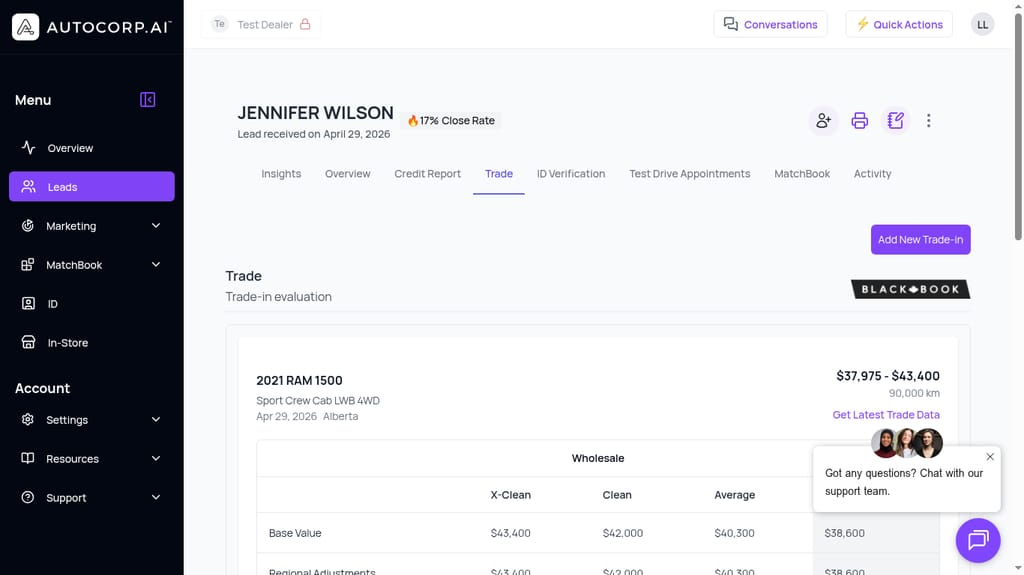
When AVA® Trade pulls Canadian Black Book data on a customer's vehicle, the wholesale valuation is broken out by condition tier (X-Clean, Clean, Average) and then adjusted for the customer's province. For a real example inside the AVA® portal, a 2021 RAM 1500 Sport Crew Cab LWB 4WD at 90,000 km in Alberta showed an X-Clean value of $43,400 and a Clean value of $42,000, with regional adjustments applied as a separate line — and a "Get Latest Trade Data" refresh built right into the record.
That's the level of granularity a sales manager needs when a customer starts negotiating trade value based on a KBB number they pulled up on their phone at the desk.
AVA® Trade: Where Pricing Discipline Pays Twice
Pricing inventory right and appraising trades right are the same skill applied in two directions. A trade that's over-allowed at appraisal shows up later as a used unit that has to be over-priced to protect gross — and then sits.
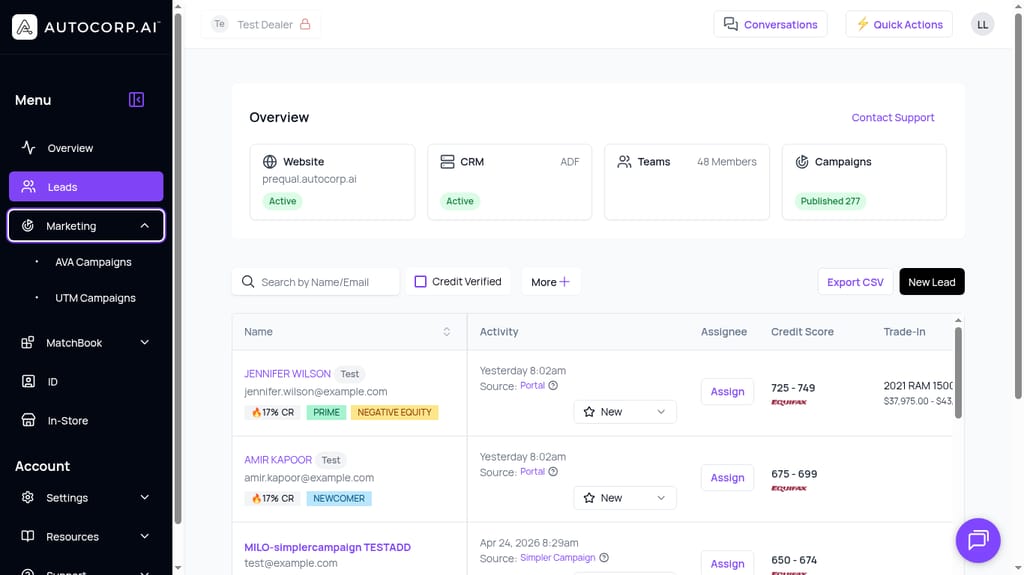
This is where AVA® Trade changes the math. Instead of the appraiser working from a separate Canadian Black Book portal, the CBB valuation appears on the lead record before the customer walks in. The sales manager knows the wholesale range, the customer's credit tier, and any equity or lien position going into the conversation.
AVA® Trade is included in Autocorp's AVA® Growth plan along with trade-in lien matching and equity detection, and it surfaces trade values directly on the lead record next to the customer's Equifax credit range. So a lead named Jennifer Wilson doesn't just show up as "interested in a Silverado" — she shows up with a 725–749 credit tier, a 2021 RAM 1500 trade valued at $37,975–$43,400 via AVA® Trade, and a Negative Equity flag. That's the information you need to price the next deal, not just close this one.
Want to see how AVA® Trade ties into credit and lender approvals? The AVA® MatchBook side of the platform pairs those trade values with inventory that fits the customer's lender approval — so a used unit isn't just priced against the market, it's matched against real buyers who can actually finance it.
When Black Book Justifies Holding Price (Instead of Cutting It)
The most common misread on data-driven pricing is that it always pushes prices down. It doesn't. There are weeks and segments where CBB wholesale is rising, and the stores that catch that early hold gross that everyone else gives up.
Some examples pulled from recent Canadian Black Book weekly market reports:
- Full-Size Pickup: +0.33% in a week where the overall market fell -0.13%. If you had two used F-150s and three used Silverados on the lot, that's a segment where you don't cut price — you hold, and let the market come to you.
- Full-Size Luxury Crossover/SUV: +0.19% in a week where truck/SUV segments overall dropped -0.39%. A used Escalade or Navigator priced on a two-week-old number is underpriced.
- Luxury Car: -0.78% in a single week. A used 5 Series held at last month's price is now 0.78% off market, and every additional week the gap widens.
AVA® le dice quién está listo para comprar antes de que su equipo mueva un dedo. Vea el flujo.
Reservar una demo →Sales managers who review CBB weekly can flag these movements and adjust before a unit ages into a problem. Managers who pull Black Book once at acquisition and never again miss the shift entirely.

Integrating AVA® Trade Into the Daily Workflow
The stores that get the most out of Canadian Black Book don't treat it as a lookup tool. They treat it as the pricing layer their whole desk runs on. That's really what AVA® Trade is built for.
That usually looks like this:
- Every new lead with a trade gets a CBB pull automatically through AVA® Trade, tied to the customer's region, with condition tiers visible before the appraiser opens the hood.
- The trade valuation lives on the lead record, not in a separate spreadsheet, so sales, F&I, and management see the same number.
- A weekly pricing review cross-references current CBB values against every used unit over 15 days old.
- Aging inventory triggers (30/45/60/75 days) each pull a fresh AVA® Trade value and a competitive scan, and the delta drives the pricing decision — not gut feel.
- Staff can defend the number to a customer because it's sourced from Canadian Black Book, a recognized authority, which shortens negotiation cycles.
The operational lift is real. Pulling a Black Book number in a separate portal, copying it into a CRM note, then walking to the desk is easily 15–20 minutes per lead. When trade valuation is embedded in the lead record through AVA® Trade, that time collapses to seconds, and nobody's working off stale data.
Where Dealers Get It Wrong
Even with Canadian Black Book available, pricing mistakes still happen. The patterns are usually the same:
- Pricing off acquisition-day CBB and never refreshing. Wholesale moves weekly. A 30-day-old number is a stale number.
- Ignoring regional adjustments. A national wholesale average isn't your market. Your province's adjustment is.
- Treating every unit in a segment the same. Two 2021 CR-Vs with a 40,000 km delta and different condition tiers should not price the same, even if the year and trim match.
- Reacting to a competitor's price cut without checking CBB first. If a competitor cut price on a unit and CBB wholesale is stable or trending up, they're probably clearing an aged unit — you don't need to follow.
- Appraising trades from memory instead of a live pull. Every trade appraised without a current AVA® Trade number is a gross gamble.
The Sales-Team Angle: Confidence in the Number
There's a soft benefit to Canadian Black Book pricing that shows up in the closing rate, not just the days-to-turn. When a customer challenges a price — either on the vehicle they're buying or the trade they're leaving — the sales team can answer with a source, not a shrug.
"Canadian Black Book shows this vehicle at $X wholesale, adjusted for your region and mileage, so our retail at $Y reflects the market" is a defensible answer. "That's what we're asking" isn't.
Sales managers I talk to say this alone reduces the number of desk deals that stall out on price disputes. The customer doesn't have to trust the dealer. They have to trust the source — and Canadian Black Book has spent decades building that trust.
Pricing Discipline Is a Competitive Advantage
Canadian dealers are operating in a market where buyers do their homework before they contact you. Roughly 220,000 used vehicles are listed on Canadian dealer lots at any given time, and buyers can compare across all of them from their phone. The 14-day moving average listing price in a recent CBB read was $34,350. That's the reference point every shopper walks in with.
If your pricing sits above the market without a data-backed reason, you don't get the click. If it sits below the market when Black Book supports a stronger number, you gave gross away for no reason.
The dealerships turning inventory faster aren't smarter about pricing than everyone else. They just run a tighter loop between Canadian Black Book data, their lead workflow, and their desking process. AVA® Trade is what closes that loop.

Frequently Asked Questions
What is AVA® Trade?
AVA® Trade is Autocorp's trade-in tool, powered by Canadian Black Book. It pulls live CBB wholesale values — with X-Clean, Clean, and Average condition tiers plus regional adjustments — directly into the lead record in the AVA® portal, alongside the customer's credit tier and any lien or equity data.
What makes Canadian Black Book different from other valuation sources?
Canadian Black Book pulls from actual Canadian wholesale transaction data, adjusted by condition tier (X-Clean, Clean, Average), mileage, and provincial region. It reflects what vehicles are transacting for at wholesale — not what dealers or private sellers are asking retail.
How often should I be pulling fresh Canadian Black Book values on active inventory?
Weekly at minimum on any unit over 15 days old. The CBB weekly market reads show segment-level moves of 0.3% to 0.8% inside a single week, so a two-week-old number can already be off-market. AVA® Trade has a "Get Latest Trade Data" refresh built into every record for exactly this.
Does using AVA® Trade mean I have to give higher trade allowances?
No. AVA® Trade gives you the Canadian Black Book wholesale range with condition adjustments so you can appraise accurately. Sometimes that means offering more (when the customer's vehicle is X-Clean and the segment is appreciating), sometimes less (when it's Average condition in a depreciating segment). The point is defensible, not generous.
How does AVA® Trade connect to credit and financing decisions?
When trade values from AVA® Trade, credit tier from AVA® Credit, and lender approvals from AVA® MatchBook all live on the same lead record, the desk can structure deals faster. A trade valued at $40K on a customer with a 725 credit score and an existing lien gets structured very differently than the same trade on a subprime customer — and AVA® surfaces all three data points together. See how AVA® works for automotive dealerships for the workflow.
How do I get AVA® Trade?
AVA® Trade is included in the AVA® Growth plan, which also bundles verified test drives, trade-in lien matching, equity detection, and equity mining SMS campaigns. See pricing and what's included.
Ready to see what pricing inventory off live Canadian Black Book data looks like inside a real dealership workflow? Book a demo of AVA® Trade and we'll walk you through the trade valuation, the credit-to-trade flow, and how it all lands on the lead record before your team ever picks up the phone.