 Activix
  AutoTrader
  Black Book
  CarGurus
  Equifax
  TransUnion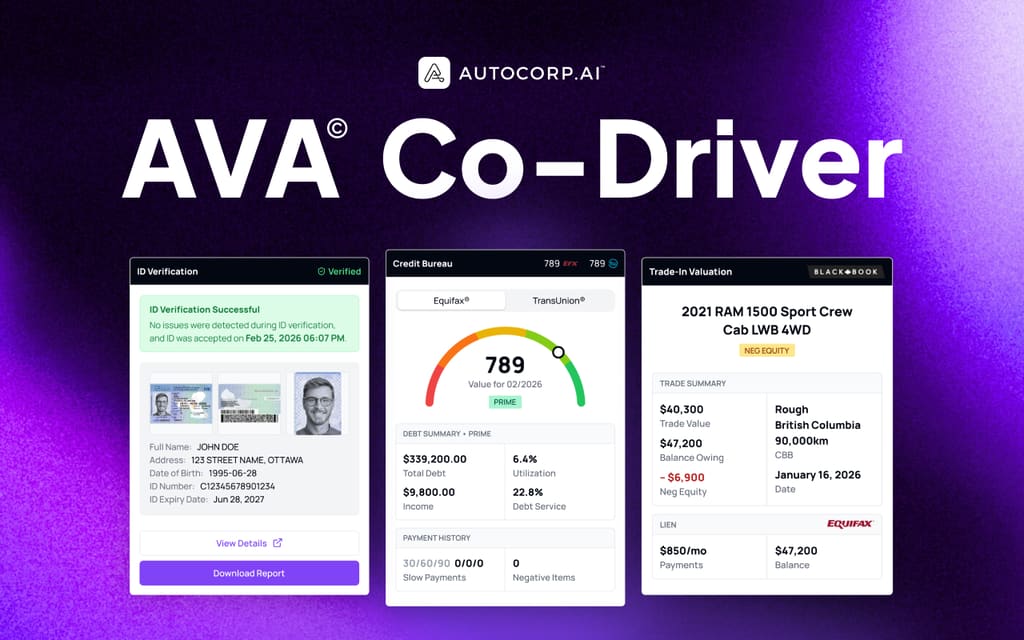


What Happens When a Fraudster Walks Into Your Showroom
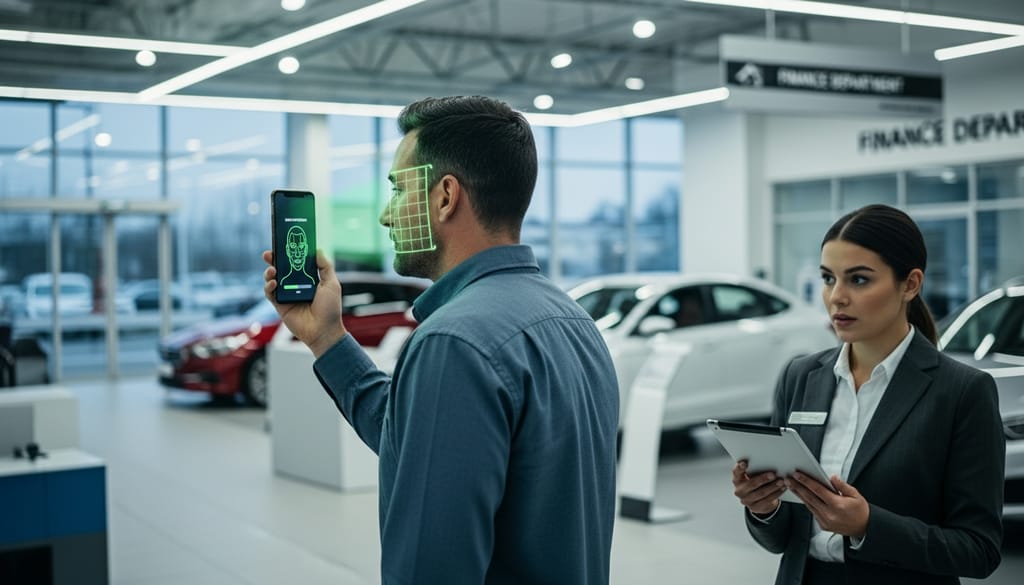
It's a Saturday afternoon. Your floor is busy. A well-dressed man walks in, points at a loaded SUV on the showroom floor, and asks about financing. He has a driver's license, a story about a recent move, and a hurry to close before the weekend ends.
Ninety minutes later, your F&I office has a signed contract, your porter has washed the vehicle, and the customer has driven off the lot. On Monday morning, your lender calls. The name on the credit application doesn't match the person who signed. The address is a mail drop. The SUV is already on a container ship.
That is the story most dealers only hear about after the fact. This is the story of how it gets stopped at the door, using AVA® ID.
The number that should make every F&I manager pay attention
Before we walk through the fraud attempt itself, look at the environment F&I teams are operating in right now.
Equifax Canada reported in its H1 2024 Market Pulse that automotive fraud is up 54% year over year, with Ontario auto fraud rates doubling since Q2 2023. Roughly 48.3% of all flagged fraud applications in Q2 2024 were identity fraud, up from 42.9% a year earlier. Synthetic identity fraud, where criminals stitch together real and fabricated data, tripled to 8% of fraud applications in the same period.
South of the border, Point Predictive's 2024 Auto Lending Fraud Trends Report put auto lender fraud loss exposure at $9.2 billion in 2024, a 16.5% jump year over year and the highest figure ever recorded. Synthetic identity and credit washing alone accounted for $2.5 billion of that number.
For a Finance Director, those numbers translate into three concrete things: chargebacks from lenders, buyback demands on funded contracts, and a slow erosion of your lender relationships every time one of these deals unwinds. One fraudulent contract on a $55,000 SUV can wipe out the gross on ten clean deals.
Now, back to the showroom.
Step 1: The application. Where the fabrication check fires.
Our fraudster, let's call him "Marcus," fills out the credit application on the tablet your BDC hands him. Name, address, date of birth, driver's license number, employer, income. Everything looks normal.
Behind the scenes, AVA® ID is doing something different than the manual eyeball check most stores rely on. When Marcus uploads a photo of his driver's license, the platform runs it through a document fabrication check. It inspects the security features that should exist on that specific class of Ontario or provincial license: the ghost image, the microprinting, the barcode contents, the fonts, the layout templates the issuing authority actually uses.
If the barcode data doesn't match the printed data on the face of the license, it flags. If the template belongs to a license class that was retired three years ago but the "issue date" is last month, it flags. If the photo has been laser-printed onto a real card stock, the physical inconsistencies show up in the scan.
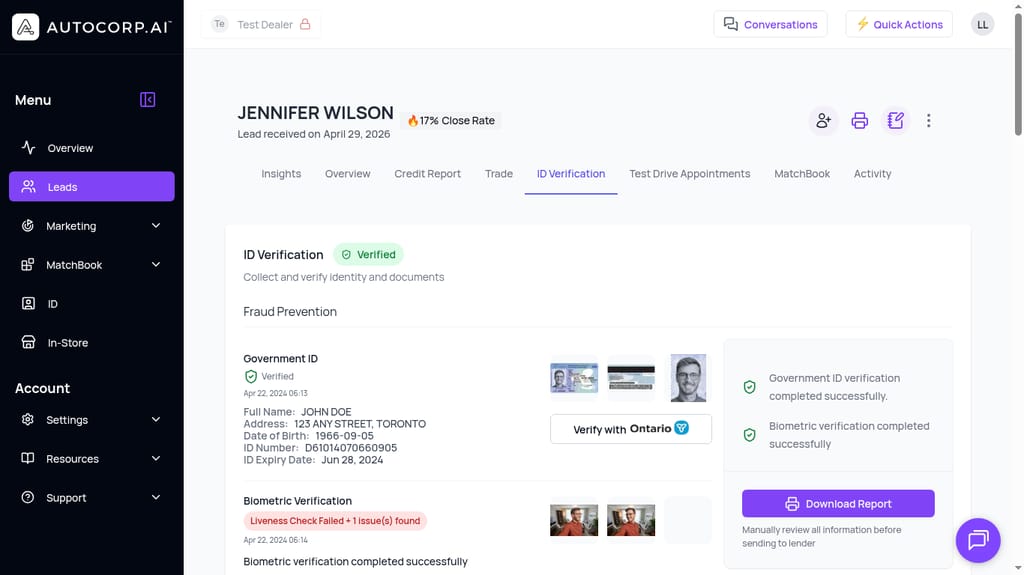
In the AVA® portal, this appears on the lead's ID Verification tab as a Government ID block with parsed fields and a status pill. When something is off, the "Verified" green shield doesn't appear. Instead, the record surfaces the specific issue so your F&I manager doesn't have to guess.
Marcus's license, in this scenario, is a good copy but not a real one. The fabrication check catches it in seconds. Deal paused.
Step 2: The "real" license. Where the tampering check fires.
Say Marcus is more sophisticated. He isn't using a wholly fabricated card. He got hold of a real license belonging to someone with a strong credit profile (Equifax notes that 40% of third-party identity fraud cases in Canada target consumers with credit scores above 800, and 76% of those victims have no prior delinquencies on file). He's carefully altered the photo and swapped the date of birth to match his own appearance.
This is where AVA® ID's tampering check comes in. The system compares what's on the license against reference templates and against itself. Pixel-level analysis looks for signs of digital editing: cloning artifacts, resolution mismatches between the photo area and the rest of the card, inconsistent lighting between fields that should have been printed at the same time, and font-rendering differences on data that has been overwritten.
If the DOB was pasted in, the tampering check sees it. If the headshot was swapped, the tampering check sees it. Your F&I manager sees a flag on the ID Verification tab in the lead record, along with the specific reason.
AVA® revisa la identificación oficial, confirma una selfie en vivo y ejecuta más de 30 verificaciones antifraude en unos 60 segundos. Véalo en vivo.
Reservar una demo →For dealers on any AVA® plan, this happens whether the ID was captured in-store on a tablet or remotely through a link sent by SMS. Same engine, same standards, applied consistently to every applicant.
Step 3: The selfie. Where the biometric match fires.
Assume, for the sake of argument, Marcus has done all the work. The card is real. The data has not been altered. He is using the license of someone whose identity he's fully stolen.
The last line of defense is the one criminals cannot rent, buy, or print: your customer's own face has to match the ID they've handed you.
AVA® ID's biometric selfie match asks the person standing at your desk to take a live selfie. The platform runs a liveness check to defeat spoofing attempts like static photos, screen replays, and printed masks, then compares the face in the selfie to the face on the government ID.
If the two faces don't match within confidence thresholds, the biometric verification fails. In the platform, this appears as a red badge on the Biometric Verification block. The right-side summary panel, which normally shows green checkmarks for "Government ID verification completed successfully" and "Biometric verification completed successfully," instead calls out the issue and instructs the reviewer to manually inspect before sending anything to a lender.
For our fraudster Marcus, this is the wall. The license belongs to a 68-year-old accountant in Mississauga. He is 34. No amount of stolen data gets him past a face that isn't his.
What this looks like in your deal jacket
For a Finance Director, the operational payoff is that every one of these checks produces a documented, timestamped record attached to the lead.
Open a lead in the AVA® portal, click the ID Verification tab, and you see the parsed government ID fields (full name, address, date of birth, ID number, expiry), thumbnails of the front and back of the document, the selfie used for the biometric match, and independent status shields for each check. A Download Report button packages the full verification for your lender file.
That report matters for two reasons. First, it satisfies KYC and AML expectations most lenders now push down to dealers as a condition of funding. Second, if a deal ever does get contested, you have a defensible record showing the checks you ran, the results, and the timestamp. That's the difference between a chargeback conversation and a chargeback fight you can actually win.
Where humans still matter
None of this replaces the judgment of a good F&I manager. The platform is designed to flag and document, not to auto-decline. The guidance next to the Download Report button says it plainly: "Manually review all information before sending to lender."
The value is that your reviewers now spend their time on the deals that actually warrant a second look, instead of squinting at every license under the desk lamp hoping to spot a bad one. Fraud checks that used to depend on the sharpest eye in the store now run on every applicant, every time, with the same standard.
The bottom line for F&I
If you're managing financing at a 50 to 200 person dealership, the math is straightforward. Auto fraud is up 54% year over year in Canada. Identity theft accounts for nearly half of all flagged fraud applications. Loss exposure across the industry hit $9.2 billion last year. First-party and synthetic identity fraud make up the majority of that number, and both are specifically designed to defeat a manual review process.
AVA® ID gives you three layered checks (fabrication, tampering, biometric match) that run before a customer ever sits down with your F&I manager, with a full report your lenders will actually accept.
You still get to make the call on every deal. You just get to make it with the facts.
Ready to see AVA® ID in your own workflow? Book a demo or explore pricing and plans built for dealerships that move real volume.