 Activix
  AutoTrader
  Black Book
  CarGurus
  Equifax
  TransUnion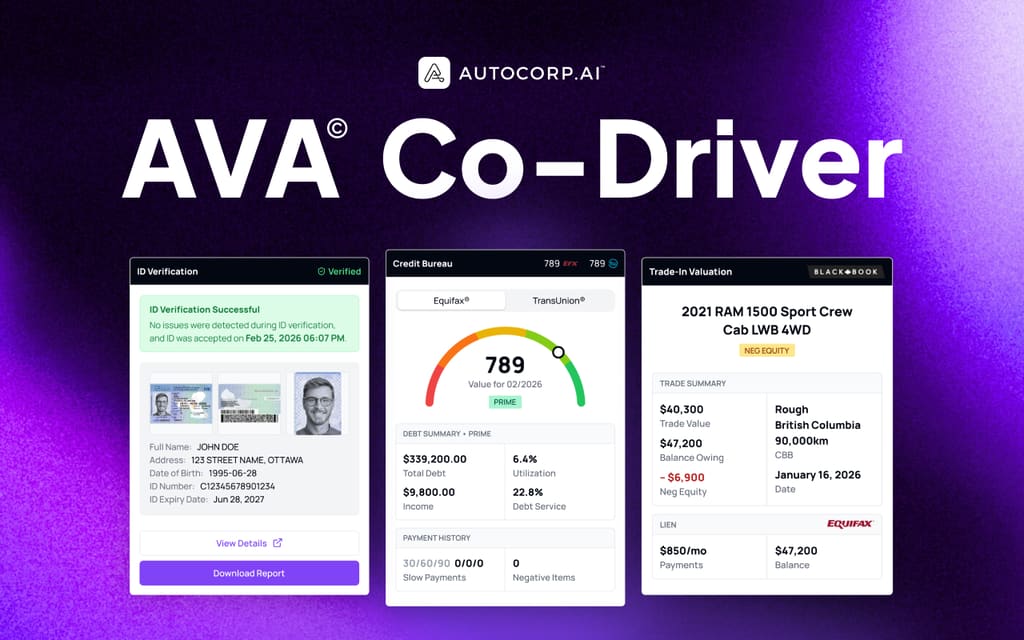
For years, dealership SEO was mostly about showing up on Google when someone searched “used RVs near me,” “Honda dealer in [city],” or “bad credit car financing.”
That still matters.
But the way shoppers find answers is changing.
Today, automotive buyers are not only scrolling through blue links. They are asking Google AI Overviews, ChatGPT, Gemini, Perplexity, voice assistants, and search tools increasingly powered by AI:
- “What is the best SUV for a family of five under $40,000?”
- “Can I finance a car/RV/boat with a 620 credit score?”
- “Should I trade in my car or sell it privately?”
- “What documents do I need to buy a boat in Ontario?”
- “Which dealership near me offers online credit pre-qualification?”
This is where AEO comes in.
AEO stands for Answer Engine Optimization. It is the practice of structuring your website, content, local presence, and product pages so search engines and AI-powered answer engines can understand your dealership, trust your expertise, and use your content to answer buyer questions.
For dealerships, this is not just a marketing trend. It is a revenue opportunity.
If your website becomes the place that clearly answers the questions shoppers are already asking, you can attract more qualified traffic, reduce friction in the buying journey, and turn more anonymous visitors into real sales opportunities.
Key Takeaways
- AEO helps your dealership show up when buyers ask AI-powered search tools specific vehicle, financing, trade-in, and local buying questions.
- The best AEO strategy is not about “hacking AI.” It is about creating helpful, expert-led content that answers real shopper questions better than generic competitors.
- Dealership websites should organize content around buyer intent: inventory, financing, trade-ins, service, local trust, and conversion.
- Structured data, Google Business Profile optimization, local pages, internal links, and clear page architecture help search engines understand your dealership.
- AEO only creates business impact when strong answers lead to strong conversion paths, such as credit pre-qualification, trade-in tools, test drive requests, and appointment booking.
- AVA Credit can support AEO by turning high-intent financing search traffic into credit-qualified leads through soft-pull pre-qualification.
What Is AEO for Automotive Dealerships?
AEO for automotive dealerships is the process of optimizing your website so it can answer buyer questions clearly, accurately, and confidently across traditional search engines and AI-powered answer engines.
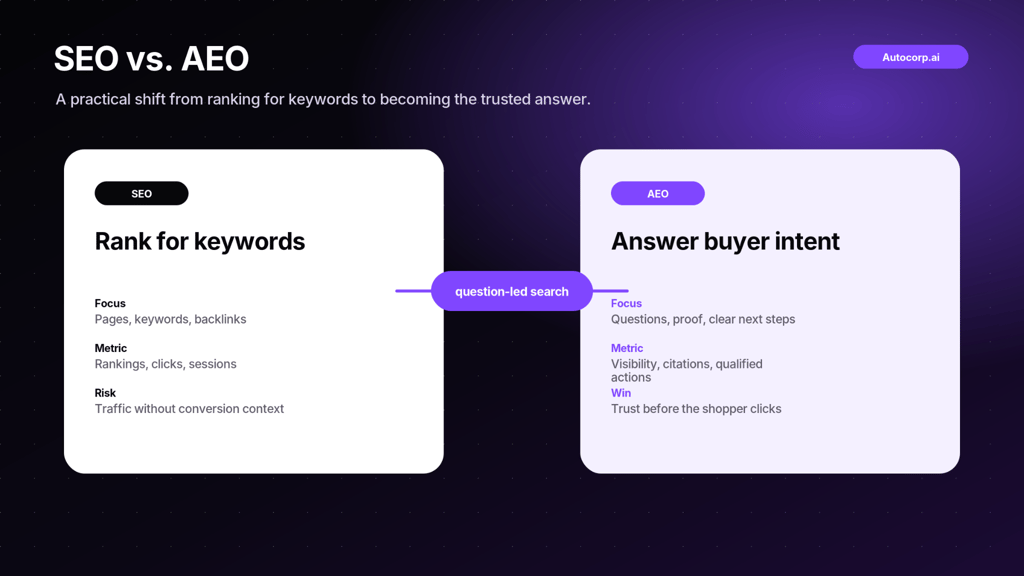
Traditional SEO asks:
“How do we rank for this keyword?”
AEO asks:
“How do we become the best answer to the buyer’s question?”
That shift matters because automotive shoppers are not always searching in short, neat keywords anymore. They are asking full questions.
Instead of searching:
“used car financing Toronto”
They may ask:
“Can I get approved for a used car loan in Toronto if I have bad credit?”
Instead of searching:
“trade-in value calculator”
They may ask:
“How do dealerships calculate the value of my trade-in?”
Instead of searching:
“best dealership near me”
They may ask:
“Which dealership near me has transparent pricing, good reviews, and online financing tools?”
AEO helps your dealership answer those questions in a way that is easy for buyers, Google, and AI systems to understand.
Why AEO Matters for Dealerships Right Now
The automotive buying journey has become more digital, more fragmented, and more research-heavy.
Buyers compare inventory, financing options, reviews, trade-in values, incentives, monthly payments, and dealership reputations long before they submit a lead. And as AI-powered search becomes more common, dealerships need to think beyond simple SEO vs. AEO keyword rankings.
Here is the bigger issue: most dealership websites are still built like digital brochures.
They show inventory. They show hours. They show OEM offers. They show a contact form.
But they often do not answer the questions buyers are actually asking.
That creates a gap.
Third-party marketplaces, lender websites, OEM sites, review platforms, Reddit threads, and automotive publishers often fill that gap instead. When that happens, the dealership loses control of the narrative before the shopper ever reaches the website.
AEO gives dealerships a way to take some of that control back.
When your website answers buyer questions with clarity and authority, you create more opportunities to show up earlier in the journey.
That means more visibility for searches like:
- “How much car can I afford?”
- “Does pre-qualification hurt my credit score?”
- “What credit score do I need to finance a car?”
- “Should I buy new or used?”
- “How does negative equity affect a trade-in?”
- “Can I trade in a car I still owe money on?”
- “What should I bring to a test drive?”
- “How does online credit approval work at a dealership?”
These are not just content topics. They are sales conversations happening before your sales team gets involved.
The Dealer Answer Layer: A Simple Framework for AEO
A strong dealership AEO strategy needs more than random blog posts. It needs an “answer layer” across your entire website.
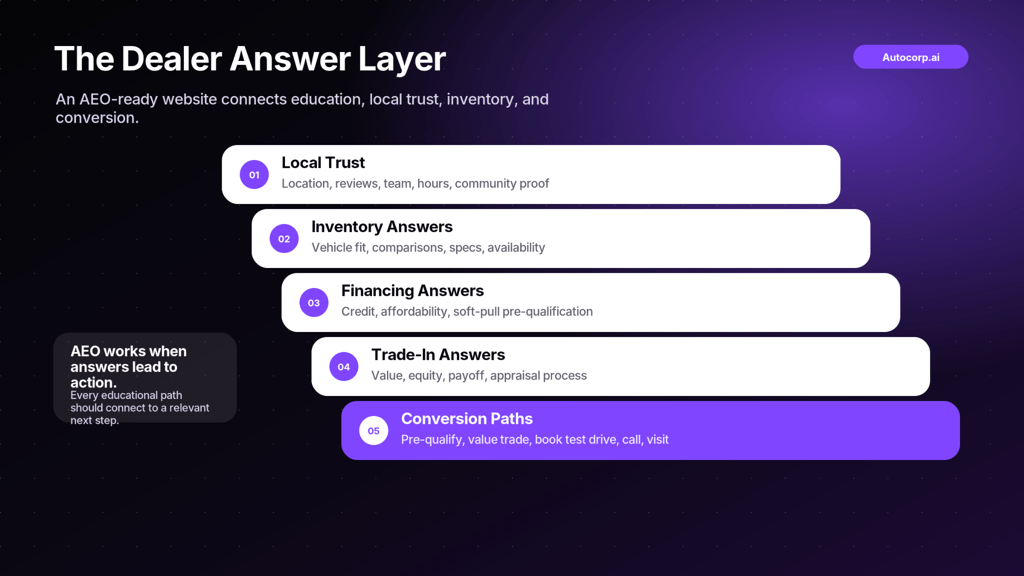
Think of your website in five layers:
- Local Trust Layer: Who are you, where are you, and why should buyers trust you?
- Inventory Answer Layer: What vehicles do you have, who are they right for, and how should buyers compare them?
- Financing Answer Layer: Can buyers afford the vehicle, qualify for financing, and understand their options?
- Trade-In Answer Layer: What is their current vehicle worth and how does equity affect the deal?
- Conversion Layer (see pricing): What should the buyer do next, and how easy is it to take action?
Most dealership websites spend the majority of effort on inventory. That is understandable. Inventory sells cars. But AEO rewards the dealership that can explain the buying journey around the inventory.
A buyer does not only need to know that a 2023 Ford F-150 is available. They also want to know:
- Is this a good truck for towing?
- What would the monthly payment look like?
- Can I get approved with my credit profile?
- How does it compare to a Ram 1500?
- Can I trade in my current truck?
- Is the dealership reputable?
- Can I start online without hurting my credit score?
AEO connects those questions into a more useful website experience.
Step 1: Map Buyer Questions to Dealership Pages
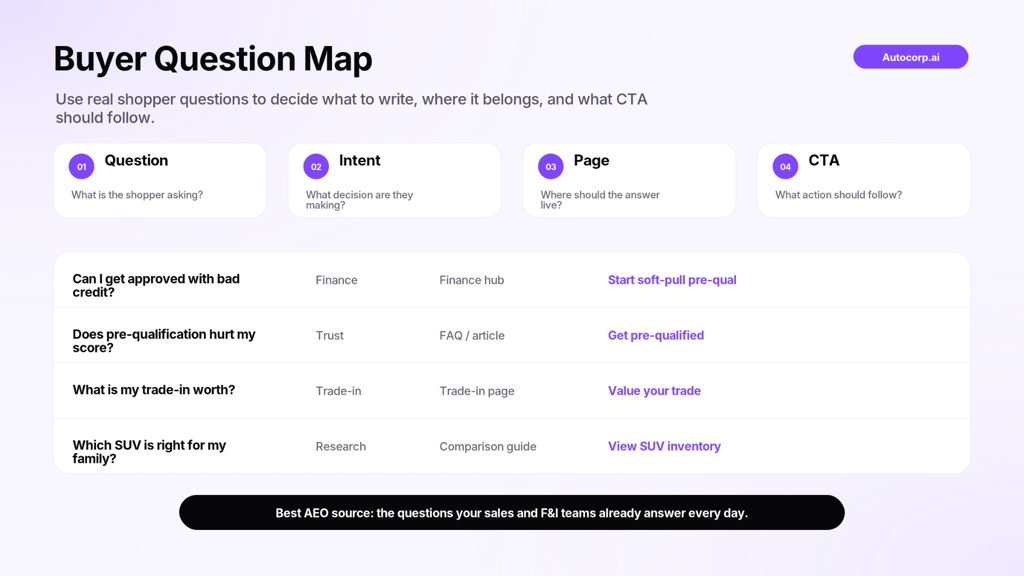
The first step in AEO is building a question map.
Do not start with keywords. Start with the questions buyers ask your sales, finance, service, and BDC teams every day.
Once you have 50 to 100 real questions, group them into content themes:
- Financing questions
- Trade-in questions
- Inventory comparison questions
- Local dealership questions
- Service and ownership questions
- Credit and approval questions
- EV, hybrid, truck, SUV, and family vehicle questions
This gives you the foundation for a content strategy that mirrors the real buyer journey.
Expert Tip
Pull question ideas from more than SEO tools. Use:
- Sales call notes
- CRM lead notes
- Website chat transcripts
- Finance office objections
- Google Search Console queries
- Google Business Profile questions
- Corrected Paid search term reports
- Reddit and forum discussions
- Competitor pages
- People Also Ask results
- Internal site search data
The best AEO content often comes from the questions your team is already answering manually.
Step 2: Build Topic Hubs Instead of One-Off Blog Posts
A common dealership content mistake is publishing disconnected blog posts with no clear structure.
Example:
- “5 Tips for Buying a Used Car”
- “How to Finance a Car”
- “Why Trade-In Values Matter”
- “Best SUVs for Families”
- “How to Improve Your Credit Score”
These topics may be useful individually, but they become much stronger when connected through topic hubs.
A topic hub is a central page that links to related subtopics.
Finance Hub
│
├── Can I finance a car with bad credit?
├── Does pre-qualification affect my credit score?
├── What credit score do I need to buy a boat?
├── What documents do I need for auto financing?
├── How does negative equity affect financing?
├── Should I choose a longer loan term?
└── How to get pre-qualified online
This structure helps buyers navigate your website and helps search engines understand that your dealership has depth on a topic.
Recommended Dealership AEO Hubs
1. Auto Financing Hub
Purpose: Capture buyers researching affordability, approval, credit, and monthly payments.
Content ideas:
- Auto financing explained
- Pre-qualification vs. pre-approval
- Bad credit car financing
- How soft credit checks work
- What documents buyers need
- How loan terms affect payments
- Negative equity explained
- First-time buyer financing
Primary CTA: Get pre-qualified
2. Trade-In Hub
Purpose: Capture buyers trying to understand vehicle value and equity.
Content ideas:
- How trade-in values are calculated
- Trade-in vs. private sale
- How negative equity works
- What affects vehicle appraisal value
- How to prepare your car for appraisal
- Can you trade in a financed vehicle?
- How taxes may affect trade-in value
Primary CTA: Value your trade
3. Local Buying Guide Hub
Purpose: Capture high-intent local searches.
Content ideas:
- Best used vehicles in [city]
- How to buy a boat in [province/state]
- Best family RVs in [city]
- Best trucks for winter driving in [region]
- Used auto financing in [city]
- Dealership checklist for [city] buyers
Primary CTA: Browse inventory or book appointment
4. Vehicle Comparison Hub
Purpose: Capture shoppers comparing models and body styles.
Content ideas:
- Sedan vs. SUV
- Gas vs. hybrid vs. EV
- Best boats for watersports
- Best used SUVs under $30,000
- Best RVs for road trips
- Best vehicles for growing families
Primary CTA: View matching inventory
Step 3: Write Answer-First Content
AEO-friendly content should answer the main question quickly before going deeper. Do not bury the answer under a long introduction.
If the page is targeting the question “Does pre-qualification hurt my credit score?” the first section should answer that directly.
Weak version:
Financing a car is an exciting step, but many shoppers have questions about credit checks. In today’s market, dealerships offer many tools to help buyers understand their options…
Better version:
No, auto loan pre-qualification typically uses a soft credit check, which does not affect the shopper’s credit score. It gives the dealership and buyer an early view of potential financing options before moving into a formal credit application or lender approval process.
That answer-first structure helps:
- Buyers get clarity faster
- AI systems extract the answer more easily
- Sales teams use the article as a follow-up resource
- Your page compete for featured snippets and AI-generated summaries
Use This AEO Writing Format
- Question-based heading
- Short direct answer
- Plain-English explanation
- Example from a dealership scenario
- Action step for the buyer
- Relevant CTA
Example: Can I Trade In a Car I Still Owe Money On?
Yes, you can trade in a vehicle that still has a loan balance. The dealership will calculate your vehicle’s trade-in value, compare it against your remaining loan payoff, and determine whether you have positive or negative equity.
For example, if your vehicle is worth $22,000 and you owe $18,000, you have $4,000 in positive equity that may be applied toward your next vehicle. If your vehicle is worth $18,000 and you owe $22,000, you have $4,000 in negative equity that needs to be handled as part of the next deal structure.
The best next step is to get an accurate trade-in estimate and speak with the finance team before choosing a vehicle.
That is useful, clear, and sales-relevant.
Step 4: Add First-Hand Expertise to Avoid Commodity Content
Generic content will not win in AEO.
A page called “7 Tips for Buying a Used Car” is not enough unless it includes dealership-specific insight, real examples, local context, expert commentary, or original data.
Search engines and AI systems are getting better at identifying whether content adds anything new or simply repeats what already exists online.
To make your dealership content feel expert-written, add:
- Quotes from your sales manager, finance manager, service manager, or dealer principal
- Local examples from your market
- Inventory-specific recommendations
- Real buyer scenarios
- Common mistakes your team sees
- Before-and-after examples
- Data from your CRM or website analytics
- Screenshots or visuals showing the process
- Short videos from your team
- Transparent explanations of trade-offs
Example: Commodity vs. Expert Content
Commodity:
Buying a used car can save you money. Make sure to check the vehicle history report, inspect the car, and take it for a test drive.
Expert:
At our dealership, the used vehicles that move fastest are not always the cheapest ones. They are usually the vehicles with the clearest story: clean history, strong reconditioning notes, transparent pricing, and payment options the buyer can understand before they visit. If two similar SUVs are priced within $1,500 of each other, the one with better photos, clearer payment expectations, and a faster financing path usually gets the lead first.
That second version feels like it came from someone who actually works in automotive retail. That is the standard your AEO content needs to meet.
Step 5: Optimize Your Inventory Pages for AI and Human Buyers
Inventory pages are often the highest-value pages on a dealership website, but many VDPs are thin from a content perspective.
They include:
- Vehicle title
- Price
- Photos
- Specs
- Basic description
- CTA buttons
That is a start, but it may not be enough for AEO. AI systems need context. Buyers need confidence.
Your VDPs should answer the questions a buyer may have before they submit a lead.
Add Helpful Answer Blocks to VDPs
Consider adding short answer sections such as:
Who is this vehicle best for?
This 2022 Toyota RAV4 is a strong fit for commuters, small families, and buyers who want SUV space without moving into a larger three-row vehicle.
What should buyers know?
The RAV4 is known for strong fuel efficiency, practical cargo space, and strong resale value. Buyers comparing compact SUVs may also want to look at the Honda CR-V, Mazda CX-5, and Hyundai Tucson.
Can I finance this vehicle?
Financing options may be available depending on credit profile, income, vehicle selection, and lender requirements. You can start with online pre-qualification to better understand your options before visiting the dealership.
Can I trade in my current vehicle?
Yes. You can apply your trade-in value toward this vehicle. If you still have a loan on your current vehicle, the finance team can help calculate whether you have positive or negative equity.
These sections help your VDPs become more useful and more answer-ready.
AVA® convierte el tráfico de su sitio y campañas en compradores con intención crediticia real. Recórralo.
Reservar una demo →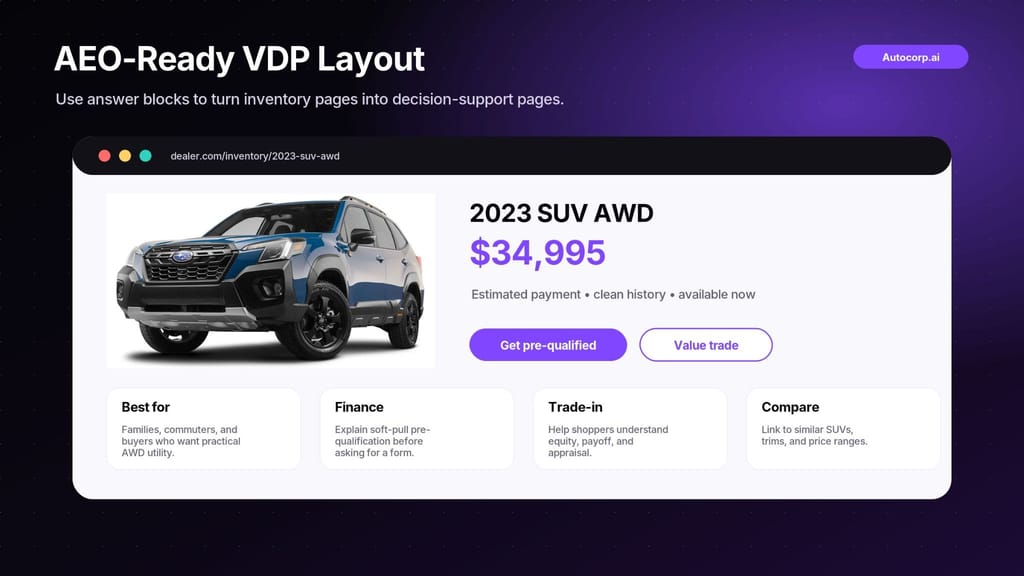
Step 6: Use Structured Data the Right Way
Structured data helps search engines understand the information on your website.
For dealerships, structured data can support:
- Local business details
- Organization information
- Breadcrumbs
- Vehicle inventory
- Product details
- Reviews, where eligible and compliant
- Article content
- Videos
- Images
- FAQs, where relevant for page clarity
Structured data is not a magic AEO button. It will not guarantee AI visibility. But it can make your website easier to understand and improve eligibility for certain search features.
Example: AutoDealer Schema
{
"@context": "https://schema.org",
"@type": "AutoDealer",
"name": "Example Motors",
"url": "https://www.examplemotors.com",
"telephone": "+1-555-555-5555",
"address": {
"@type": "PostalAddress",
"streetAddress": "123 Main Street",
"addressLocality": "Toronto",
"addressRegion": "ON",
"postalCode": "M1M 1M1",
"addressCountry": "CA"
}
}
Important Note About FAQ Schema
FAQs are still useful for AEO because they organize answers clearly. However, do not rely on FAQ schema as a rich-result tactic. Google has reduced and deprecated FAQ rich result visibility for most websites. Use FAQs because they help buyers, not because you expect a guaranteed search enhancement.
Step 7: Strengthen Your Google Business Profile
For dealerships, AEO and local SEO are connected.
AI-powered search tools often rely on business information from trusted local sources, and Google Business Profile remains one of the most important sources of dealership information.
Your Google Business Profile should be complete, accurate, and active.
Optimize These Google Business Profile Fields
- Dealership name
- Primary category
- Secondary categories
- Address
- Phone number
- Website
- Hours
- Holiday hours
- Service department hours
- Photos
- Products or services
- Appointment links
- Inventory links, where available
- Reviews
- Q&A
- Business description
Add Buyer-Focused Q&A
Use the Q&A section to answer questions like:
- Do you offer online credit pre-qualification?
- Can I trade in a vehicle I still owe money on?
- Do you sell used vehicles?
- Do you offer service appointments online?
- Can I book a test drive online?
- What should I bring when buying a vehicle?
- Do you work with first-time buyers?
Keep answers clear, accurate, and consistent with your website content. Consistency matters.
If your website says you offer online pre-qualification, your Google Business Profile should support that. If your GBP says your finance department closes at 6 p.m., your website should not say 7 p.m.
AI systems are more likely to trust brands with consistent information across sources.
Step 8: Build Local Authority With Better Location Pages
Many dealership location pages are too thin.
Welcome to our dealership in [city]. We sell new and used vehicles. Contact us today.
That is not enough. A strong location page should answer local buyer questions and prove that the dealership is relevant in that market.
What to Include on a Local Dealership Page
- Dealership name, address, phone number, and hours
- Embedded map
- Directions from nearby communities
- Local inventory links
- Financing options
- Trade-in options
- Service department details
- Local reviews or testimonials
- Staff or department highlights
- Nearby landmarks
- FAQs specific to that location
- Links to relevant model, finance, and trade-in pages
- Clear CTAs
Example Local Page Sections
- H1: Used Cars and Auto Financing in Mississauga
- H2: Shop Used Vehicles Near Mississauga
- H2: Get Pre-Qualified Online Before You Visit
- H2: Trade In Your Current Vehicle
- H2: Directions From Nearby Communities
- H2: Why Local Buyers Choose Our Dealership
- H2: Frequently Asked Questions
- H2: Book Your Visit
This gives search engines and AI systems far more context than a basic location page.
Step 9: Make Your Content Easy for AI Systems to Extract
AEO-friendly content should be easy to parse.
That does not mean writing robotic content. It means organizing your expertise clearly.
Use:
- Descriptive H2s and H3s
- Short paragraphs
- Answer-first sections
- Tables
- Bullet points
- Step-by-step instructions
- Original examples
- Comparison blocks
- Definitions
- Clear CTAs
- Descriptive image alt text
- Internal links
- External citations where appropriate
Question-based headings are especially useful because they mirror how buyers search and how AI systems interpret intent.
Step 10: Add Helpful Visuals and Videos
AEO is not only about text.
Google’s guidance for AI search also emphasizes high-quality images and videos where they help users. For dealerships, visuals are a major advantage because automotive is naturally visual.
Use visuals to explain:
- Financing steps
- Trade-in process
- Test drive process
- Vehicle comparison
- Buying checklist
- Negative equity
- Credit pre-qualification
- Online-to-showroom journey
Recommended Visuals for This Article
- SEO vs. AEO Comparison: Show how search is shifting from ranking pages to answering questions.
- Dealer Answer Layer Framework: Show the five layers of an AEO-ready dealership website.
- Buyer Question Map: Show how dealers can turn real buyer questions into pages, sections, and CTAs.
- AEO-Ready Vehicle Detail Page: Show where answer blocks should appear on VDPs.
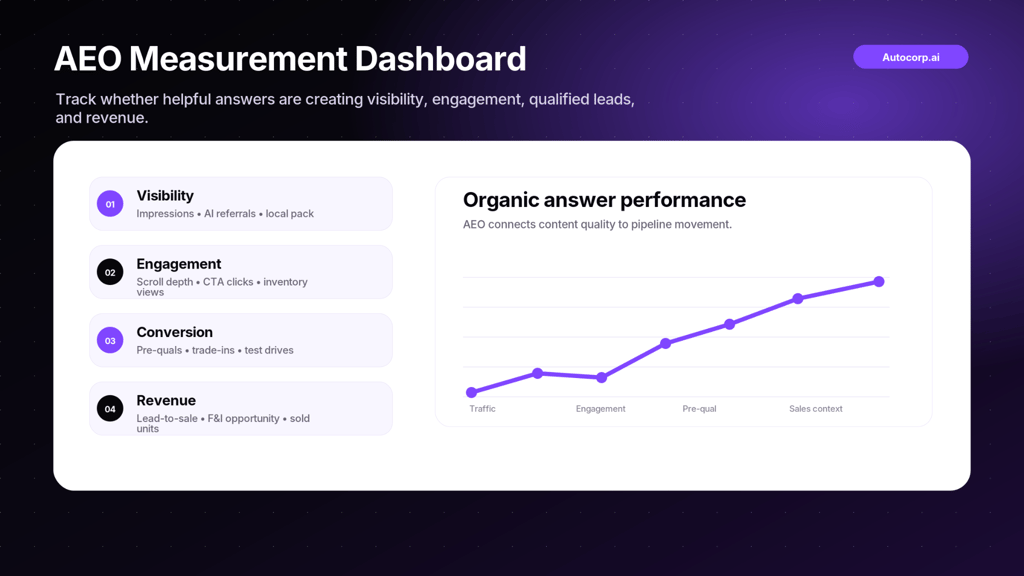
- AEO Measurement Dashboard: Show what to track beyond rankings.
Step 11: Connect Every Answer to a Conversion Path
AEO without conversion is just education. Education is important, but dealerships need pipeline.
Every AEO page should have a next step that matches the buyer’s intent.
The goal is to avoid dead-end content.
If someone reads your article about pre-qualification, the next logical action should not be “contact us” buried in the footer.
See what you may qualify for with a soft credit check.
That CTA is specific, relevant, and aligned with the buyer’s question.
Step 12: Build Trust Signals Into Every Important Page
AEO depends heavily on trust.
If your dealership is asking buyers to submit personal information, start financing, book a test drive, or value a trade, you need to reduce uncertainty.
Add trust signals near conversion points:
- Google review rating
- Recent customer testimonials
- Years in business
- OEM certifications
- Financing partner logos, where permitted
- Privacy and security language
- Clear soft-pull credit explanation
- No-impact-to-credit messaging, where accurate
- Staff photos
- Dealership awards
- Transparent process steps
- “What happens next?” explanations
Example Trust Block for a Credit Pre-Qualification CTA
Start With Confidence
Our online pre-qualification process uses a soft credit check, so shoppers can better understand their financing options without impacting their credit score. Once submitted, our team can review the information and help match the buyer with vehicles and financing options that fit their situation.
Trust is especially important for finance-related pages because shoppers are often hesitant to submit credit information online. The more clearly you explain the process, the less friction you create.
Step 13: Measure AEO Performance Beyond Rankings
Traditional SEO reporting focuses on rankings, clicks, and organic traffic. Those still matter. But AEO needs a wider scorecard.
Search Visibility Metrics
- Organic impressions
- Organic clicks
- Average position
- Featured snippet ownership
- Local pack visibility
- Branded search volume
- Google Business Profile views
- Google Business Profile calls
- Google Business Profile direction requests
AI Visibility Metrics
- Referral traffic from AI platforms
- Mentions in AI search tools
- Pages cited by AI systems
- Queries where your brand appears in AI answers
- Branded vs. non-branded AI visibility
Engagement Metrics
- Scroll depth
- Time on page
- Clicks to inventory
- Clicks to finance tools
- Video engagement
- Internal link clicks
- CTA engagement
Conversion Metrics
- Credit pre-qualification starts
- Credit pre-qualification completions
- Trade-in leads
- Test drive bookings
- Calls
- Form fills
- Appointments
- Demo or sales meetings
- Sold units influenced by organic content
Revenue Metrics
- Organic lead-to-appointment rate
- Organic lead-to-sale rate
- Cost per organic lead
- Gross profit influenced by organic leads
- F&I opportunities generated
- Trade-in opportunities generated
AEO should not be judged only by whether traffic goes up. In AI search, some users may get answers before they click. That means impressions, brand visibility, assisted conversions, and higher-intent website actions become more important.
Step 14: Create a 90-Day AEO Action Plan for Your Dealership
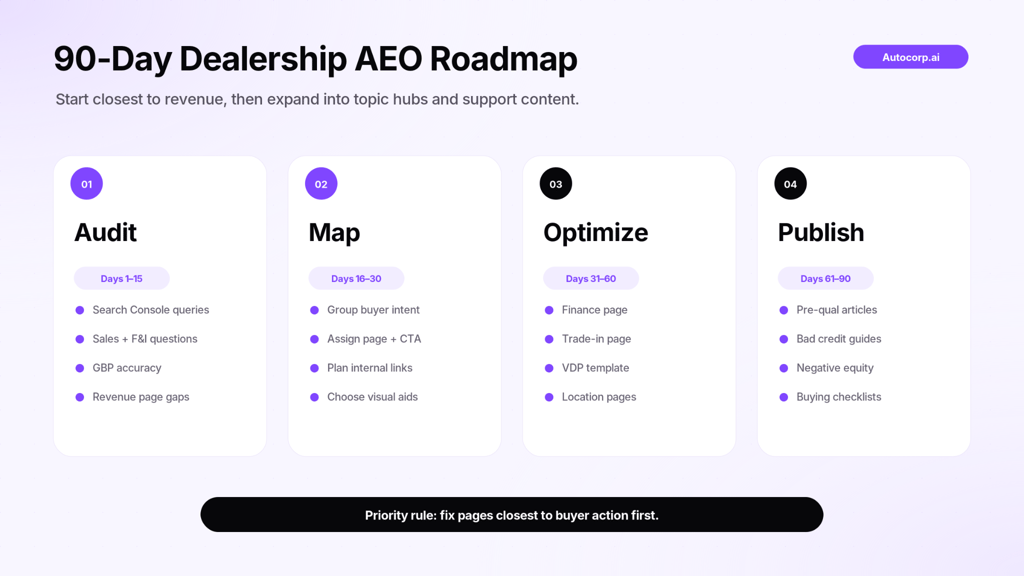
AEO can feel overwhelming, but dealerships do not need to fix everything at once. Start with the pages closest to revenue.
Days 1–15: Audit and Prioritize
- Review Google Search Console queries
- Pull top questions from sales, finance, BDC, and chat logs
- Identify top organic landing pages
- Find pages with high impressions but low CTR
- Audit finance, trade-in, and VDP pages
- Review Google Business Profile accuracy
- Check page speed and mobile usability
- Identify missing schema
Deliverable: A prioritized AEO opportunity list.
Days 16–30: Build the Question Map
- Group questions by topic
- Map each question to a page
- Identify content gaps
- Choose primary CTAs
- Build internal link plan
- Decide which pages need visuals or video
Deliverable: Dealership AEO content map.
Days 31–60: Optimize Revenue Pages
- Finance page
- Credit pre-qualification page
- Trade-in page
- Top VDP template
- Top model pages
- Location pages
- Google Business Profile
- Answer-first copy
- FAQs
- Trust signals
- Better CTAs
- Internal links
- Structured data
- Visual aids
- Short explanatory videos
Deliverable: Optimized BOFU and MOFU pages.
Days 61–90: Publish Supporting Content
- Pre-qualification vs. pre-approval
- Does pre-qualification hurt your credit score?
- How much car can I afford?
- Can I finance a car with bad credit?
- Can I trade in a car with negative equity?
- What documents do I need to buy a car?
- How to choose the right used SUV
- How to compare monthly payments
Deliverable: AEO content cluster connected to conversion pages.
Common AEO Mistakes Dealerships Should Avoid
Mistake 1: Publishing Generic AI-Written Blog Posts
AI can help draft content, but dealership content needs expert review, local context, examples, and accuracy.
A generic post that says “Buying a car is an exciting journey” will not differentiate your dealership.
Mistake 2: Creating Too Many Thin Pages
Do not create separate pages for every keyword variation.
Example: Bad credit car financing Toronto, poor credit car financing Toronto, low credit score car financing Toronto, no credit car financing Toronto.
That can become thin and repetitive. Instead, create one strong finance hub with sections that answer each related question naturally.
Mistake 3: Treating AEO as Only a Blog Strategy
AEO applies to your whole website: homepage, inventory pages, finance pages, trade-in pages, location pages, model pages, staff pages, service pages, blog content, and Google Business Profile.
Mistake 4: Forgetting the CTA
If a buyer reads about financing, give them a finance CTA. If they read about trade-ins, give them a trade-in CTA. If they compare SUVs, send them to SUV inventory.
Do not make every page rely on the same generic “Contact Us” button.
Mistake 5: Ignoring Sales Team Knowledge
Your sales and finance teams are your best source of AEO content ideas.
If shoppers ask the same question every week, that question deserves a page, section, video, or FAQ.
How AVA Credit Helps Dealers Turn AEO Traffic Into Qualified Leads
AEO can help your dealership attract more high-intent shoppers.
But visibility is only the first step.
The real opportunity is turning those shoppers into qualified opportunities before they leave your website.
That is where AVA Credit can help.
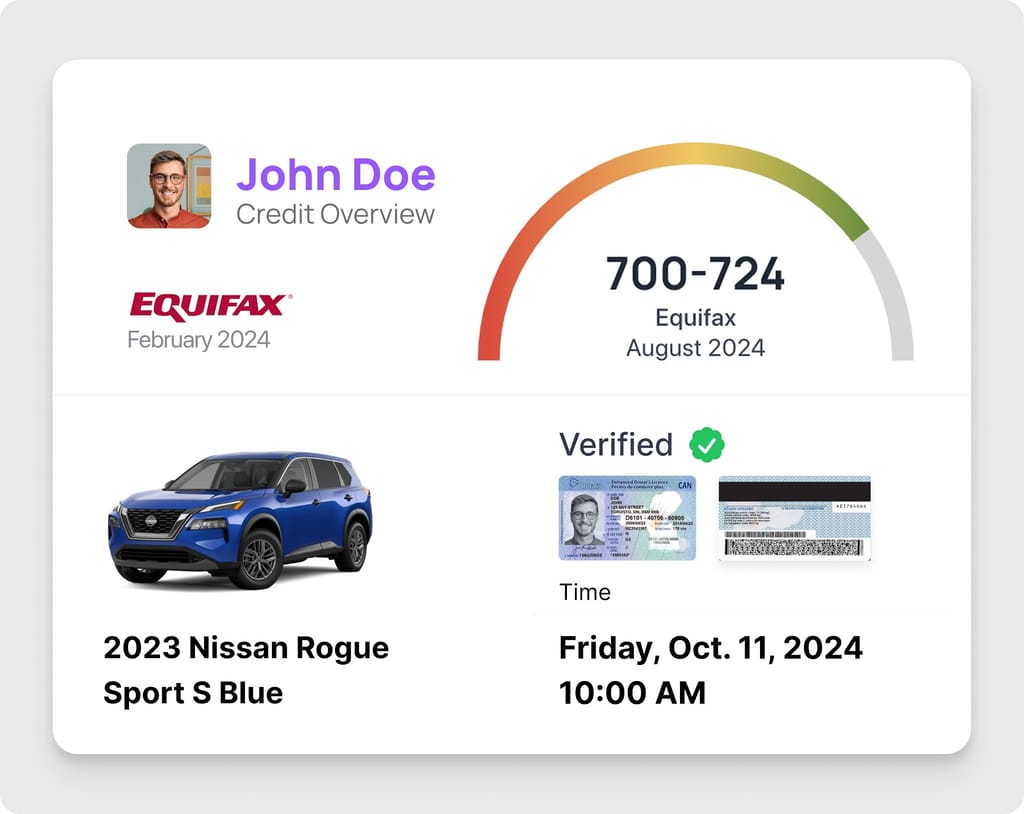
AVA Credit gives dealerships a way to add online credit pre-qualification to the buyer journey, allowing shoppers to better understand their financing options through a soft credit pull that does not impact their credit score.
For AEO, this matters because many high-intent automotive searches are finance-related.
Buyers are asking:
- “Can I get approved for a car loan?”
- “Does pre-qualification hurt my credit?”
- “What credit score do I need to buy a car?”
- “How much car can I afford?”
- “Can I finance a vehicle with bad credit?”
- “Can I trade in my car if I still owe money?”
If your website answers those questions and gives shoppers a low-friction next step, you are not just educating them. You are creating a conversion path.
The AEO-to-Conversion Flow
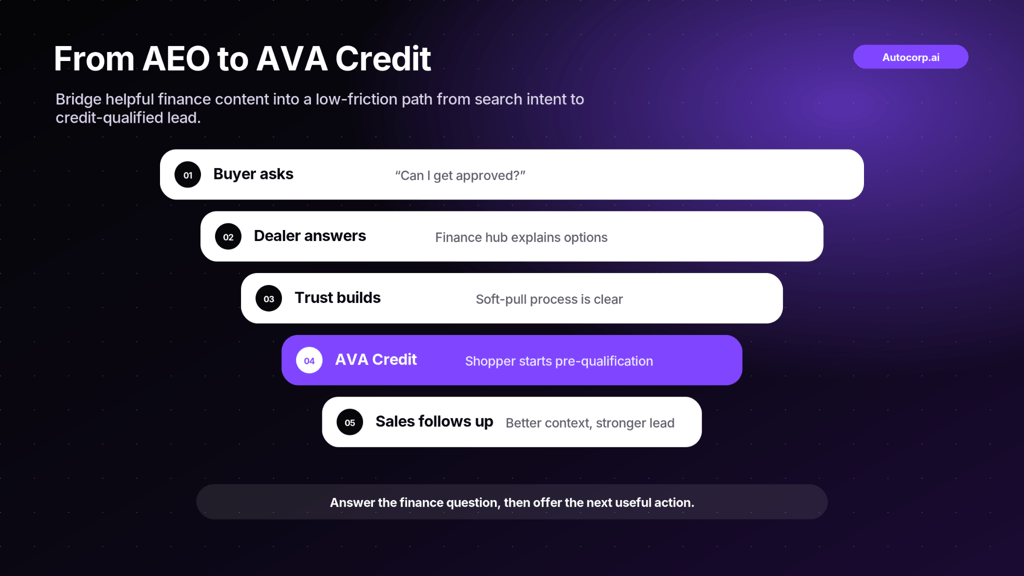
- Buyer asks finance question
- Dealer article or finance page answers clearly
- Page explains soft-pull pre-qualification
- Buyer starts AVA Credit flow
- Dealer receives a more qualified lead
- Sales and F&I can follow up with better context
This is the bridge between search performance and sales performance.
Instead of driving traffic to a generic finance form, dealerships can use AVA Credit to create a more helpful experience:
- Buyers get a clearer path forward
- Sales teams get better lead context
- F&I teams can start conversations earlier
- Marketing can connect educational content to measurable conversions
- The dealership can reduce friction between first search and first serious conversation
In a market where shoppers are doing more research before they submit a lead, that matters.
AEO helps your dealership become the trusted answer. AVA Credit helps turn that trust into action.
Final Thoughts: The Best Answer Wins
AEO is not about chasing the latest search trend.
It is about building a dealership website that is genuinely more helpful than the alternatives.
The dealerships that win in AI-powered search will be the ones that:
- Answer real buyer questions
- Explain financing clearly
- Make trade-ins easier to understand
- Provide strong local trust signals
- Use structured data responsibly
- Create expert-led content
- Add visuals and videos that simplify decisions
- Connect education to conversion
The future of dealership search will not only reward the biggest websites. It will reward the clearest, most useful, most trustworthy answers.
And for dealerships willing to turn their website into a true buyer education and conversion engine, that creates a serious advantage.