 Activix
 AutoTrader
 Black Book
 CarGurus
 Equifax
 TransUnion

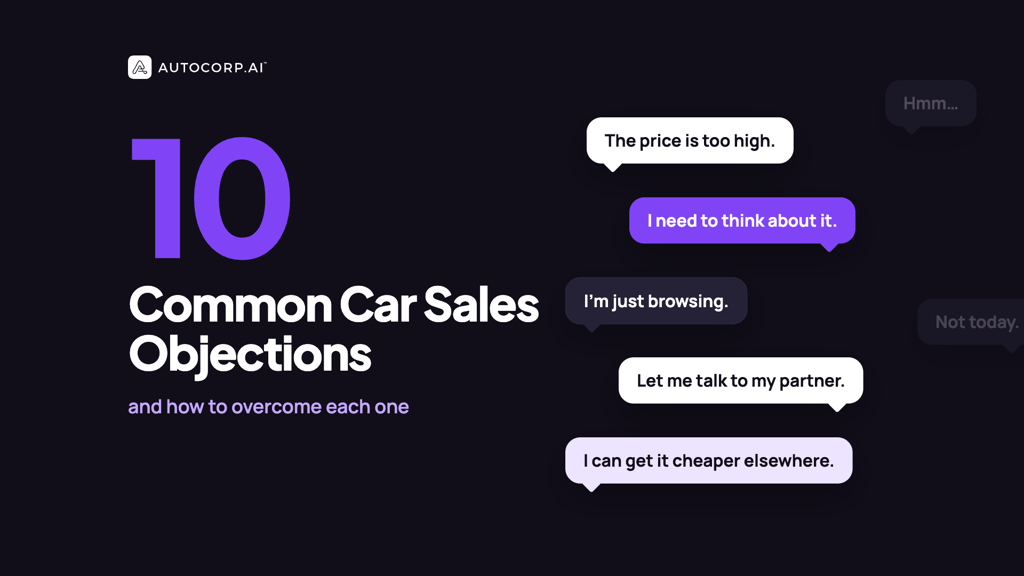
Every salesperson on your floor hears the same objections, week after week. “The price is too high.” “I need to think about it.” “I’m just browsing.”
The reps who struggle hear those lines as rejection. The reps who last hear them as information. An objection is a customer telling you what they need before they can say yes. Someone who has truly moved on doesn’t object. They just leave.
Here are the 10 objections dealerships hear most, what each one usually means, and what to say back.
A simple way to handle any objection
Before the list, here’s a method that works for all of them. It’s a widely used framework called LAER: Listen, Acknowledge, Explore, Respond.
- Listen. Let the customer finish. Jumping in halfway with a rebuttal tells them you weren’t really listening.
- Acknowledge. Show you heard the concern, without arguing with it or brushing it off.
- Explore. Ask a question to find the real concern. The first objection is often not the real one.
- Respond. Answer the concern you uncovered, with facts, options, or a clear next step.
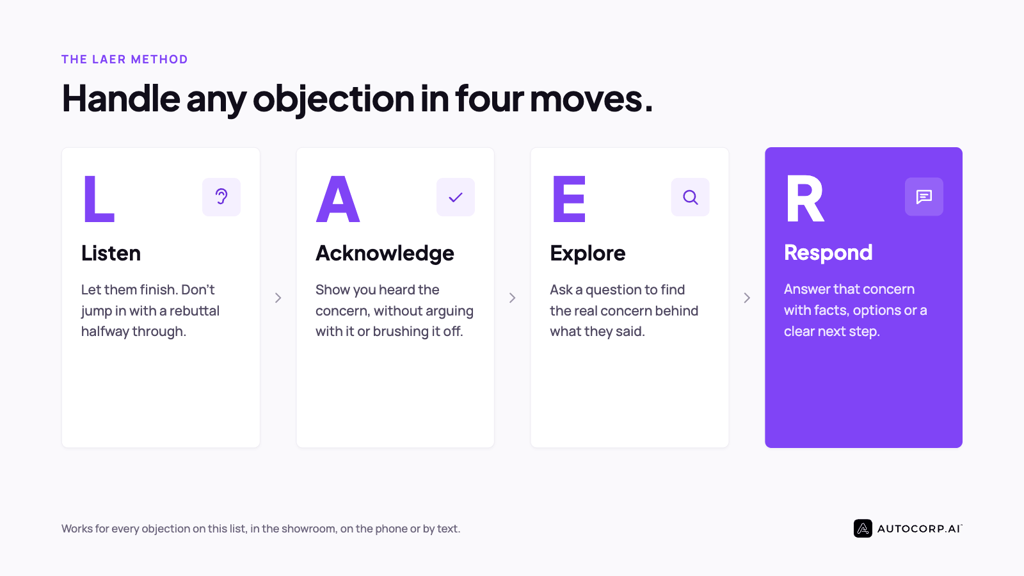
The most skipped step is Explore. When a customer says “the price is too high,” the fastest way to lose them is to defend the price before you know what they’re actually comparing it to.
1. “I’m just browsing.”
What it usually means: “I’m not ready to be sold to.” The customer isn’t saying no. They’re protecting themselves from pressure.
How to handle it:
- Don’t fight it. Agree with it and take the pressure off.
- Ask open questions about what they drive now and what they wish were different about it.
- Position yourself as a resource, not a closer. Browsers become buyers when they feel understood.
Strong rapport starts in this moment. Here’s more on building rapport with customers.
Try this: “Browsing is the best way to start. What are you driving now, and what would you change about it if you could?”
2. “I’m happy with my current vehicle.”
What it usually means: “I haven’t been given a reason to change.” It’s an opening, not a wall.
How to handle it:
- Ask how long they’ve had it and how many kilometres are on it.
- Find out what would make them consider something newer: space, fuel costs, reliability, features.
- Show them what their vehicle is worth today. A trade value that’s higher than expected changes the conversation fast.
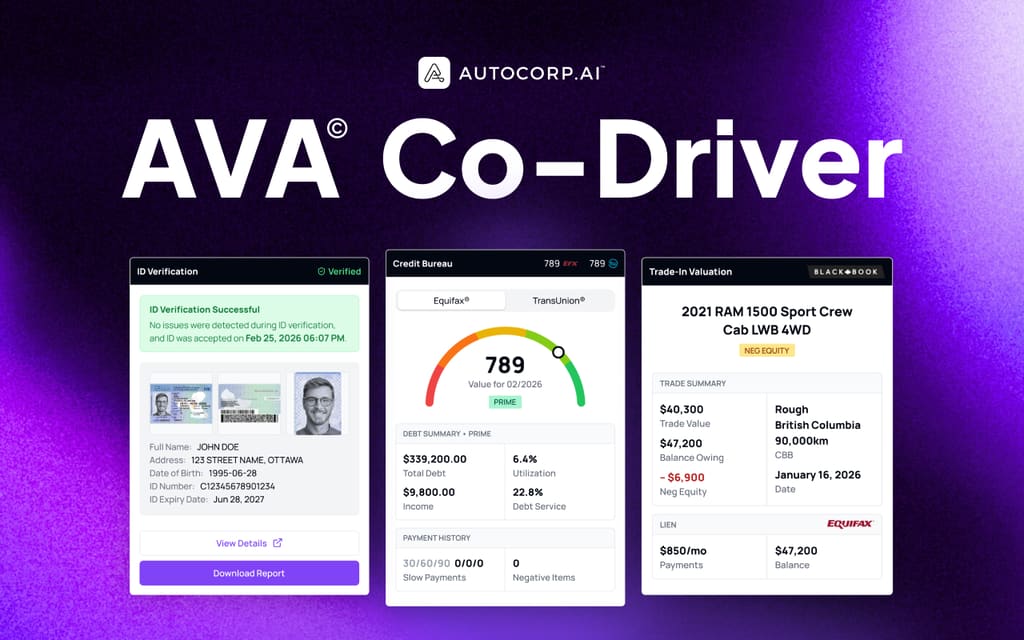
This is one place where the right tool earns its keep. With AVA® Trade, your team can give customers a Canadian Black Book trade value with equity and lien details, so the upgrade conversation starts with real numbers. Transparent values also build trust, which we cover in how accurate appraisals increase customer trust.
Try this: “Makes sense. How many kilometres are on it now? A lot of people don’t think about upgrading until they see what their vehicle is actually worth.”
3. “I don’t trust dealerships.”
What it usually means: “I’ve had a bad experience before.” This one stings, but it’s honest, and honesty is a good sign.
How to handle it:
- Thank them for saying it. Then prove it’ll be different, one step at a time.
- Walk through every number and every fee. No surprises at the desk.
- Point them to your reviews and share real stories from customers who felt the same way walking in.
Trust is built through a consistent, no-pressure process, not a great pitch. If your reviews need work, start with this guide to Google reviews for car dealers.
Try this: “I appreciate you telling me that. All I can do is walk you through everything openly and let you decide. If anything ever feels off, tell me and we’ll stop.”
4. “The price is too high.”
What it usually means: “I don’t see enough value yet,” or “this is more than I planned to spend.” Those need different answers, so find out which one it is.
How to handle it:
- Ask what they’re comparing it to: another vehicle, another dealership, or their budget.
- If it’s value, connect the price to what matters to them: safety, warranty, fuel savings, resale value.
- If it’s budget, talk monthly terms or look at a different trim or model. Don’t keep defending a number they can’t afford.
Pricing surprises late in the deal are a major cause of closing friction. The M.A.S.T. Transparent Close is a good model for putting numbers on the table early.
Try this: “Fair enough. Can I ask what you’re comparing it to? I want to make sure I’m solving the right problem.”
5. “I can get it cheaper somewhere else.”
What it usually means: “Give me a reason to buy from you.” Often the customer has seen an online price without the full picture.
How to handle it:
- Don’t panic, and don’t badmouth the competitor. Ask what they saw and where.
- Compare the full picture: fees, warranty, service, included extras, and the trade offer.
- Sell what makes your store different: your service department, your people, and how you treat customers after the sale.
Try this: “That’s worth checking. Do you know what’s included in that price? Once you compare fees, warranty, and the trade offer, the gap often looks pretty different.”
6. “The monthly payment is too high.”
What it usually means: “This structure doesn’t fit my budget.” It’s often a deal-structure problem, not a vehicle problem.
How to handle it:
- Ask what monthly payment they’re comfortable with, then work backward.
- Look at the levers: term, down payment, lender options, and the vehicle itself.
- If negative equity is in the mix, be upfront about it and find a vehicle that fits their real situation.
For deals where the trade is underwater, here’s a repeatable system for fixing negative equity.
Try this: “Let’s make it fit. What monthly payment would feel comfortable? There are a few levers we can pull, and I’d rather find the right fit than push you past your budget.”
7. “I don’t know if I’ll get approved.”
AVA® shows reps a soft-pull score, trade equity and verified ID before the first call, so the conversation starts on facts. See it on your own leads.
Book a demo →What it usually means: “I’m worried about my credit, and I don’t want to be embarrassed.” When this comes up at the desk, it usually means credit came up too late in the process.
How to handle it:
- Bring credit into the conversation early, before the test drive, in a judgment-free way.
- Explain the difference between checking their options and formally applying. Here’s a guide to pre-qualification vs. pre-approval.
- Offer a soft credit check. It doesn’t affect their credit score, so there’s no downside to knowing where they stand.
This is the objection credit qualification was built for. AVA® Credit lets customers complete an Equifax soft pull from your website or a text link, so your team knows what’s realistic before the conversation starts. If you’re new to the process, start with how to do a soft pull as a car dealer.
Try this: “Let’s take the guesswork out of it. We can do a soft credit check that won’t affect your score, and then we’ll know exactly what we’re working with.”
8. “I need to talk to my partner.”
What it usually means: Exactly what it says, or a polite way to step back. Either way, respect it.
How to handle it:
- Invite their partner in, or offer a video call or a second appointment.
- Ask what their partner will want to know, and answer those questions now.
- Send them home with everything in writing: the vehicle, the numbers, and the trade value.
You’re selling to two people, even when only one is in the room.
Try this: “Of course. What do you think their first question will be? Let’s get you the answer now so that conversation is easy.”
9. “I need to think about it.”
What it usually means: “I have a concern I haven’t said out loud yet.” It’s almost always a placeholder.
How to handle it:
- Gently ask what specifically they’re weighing: the price, the vehicle, the timing?
- Answer what you can on the spot.
- If they still need time, book a specific follow-up instead of leaving it open-ended.
Try this: “Take all the time you need. Can I ask what part you’re still thinking through? I’d rather answer it now than have you leave with an open question.”
10. “I’m not ready to make a decision today.”
What it usually means: “I feel rushed or overwhelmed.” The customer is still interested but needs the pressure turned down.
How to handle it:
- Agree with their timeline instead of pushing against it.
- Ask what would need to happen for them to feel ready.
- Keep them engaged with a clear, low-pressure next step.
Try this: “That’s completely fine. What would need to happen for you to feel ready? Even if it’s not today, I want you to have everything you need when you are.”
Quick reference: all 10 objections at a glance
| Objection | What it usually means | Your first move |
|---|---|---|
| “I’m just browsing.” | Don’t pressure me. | Agree, then ask what they drive now. |
| “I’m happy with my current vehicle.” | Give me a reason to change. | Ask about kilometres and show their trade value. |
| “I don’t trust dealerships.” | I’ve been burned before. | Thank them, then walk through every number openly. |
| “The price is too high.” | I don’t see the value, or it’s over budget. | Ask what they’re comparing it to. |
| “I can get it cheaper elsewhere.” | Give me a reason to buy here. | Compare the full picture, not just the price. |
| “The monthly payment is too high.” | This structure doesn’t fit my budget. | Ask their comfortable payment and work backward. |
| “I don’t know if I’ll get approved.” | I’m worried about my credit. | Offer a soft credit check with no score impact. |
| “I need to talk to my partner.” | The decision is shared. | Answer their partner’s questions now. |
| “I need to think about it.” | I have a concern I haven’t said yet. | Ask what specifically they’re weighing. |
| “I’m not ready today.” | I feel rushed. | Agree, then ask what would make them ready. |
How to stop objections before they start
Look at where these objections show up in a deal, and a pattern appears. The money objections (price, payment, approval, and “cheaper elsewhere”) all land at the desk. That’s the most expensive place to hear them, because everyone has already invested time in the deal.
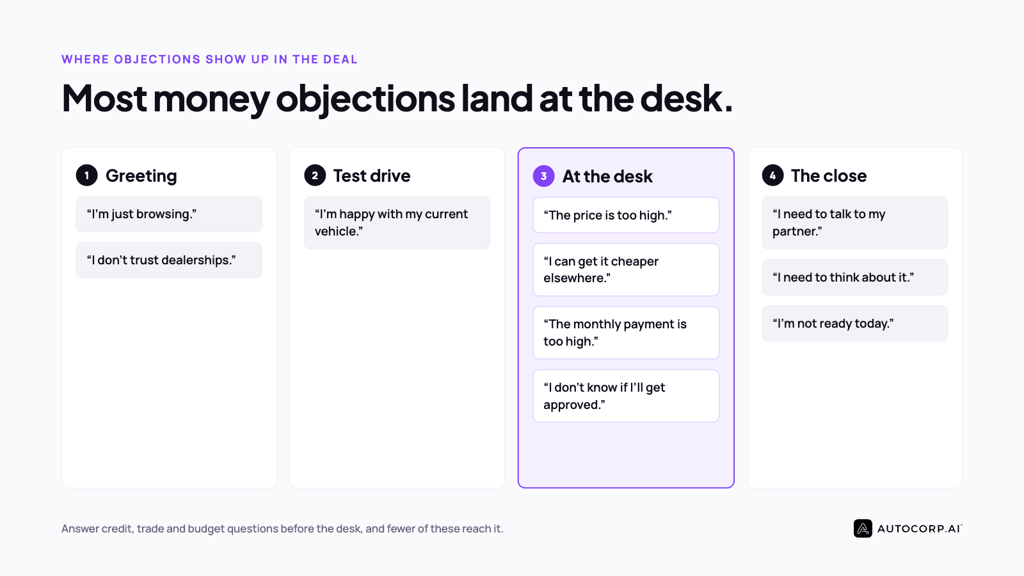
The fix is moving those answers earlier. When your team knows a customer’s budget, credit picture, and trade value before the test drive, the deal you structure is closer to one the customer can say yes to. Here’s how to qualify leads before the first call.
The other half is preparation. The reps who handle objections best aren’t naturally better under pressure. They’ve just heard every version before. Run objection drills in your weekly meetings, role-play the hardest ones, and build a shared playbook so your whole floor responds consistently. More on why training matters at your dealership.
Don’t let an open objection become a lost deal
Not every objection gets resolved on the floor, and that’s okay. A customer who leaves with an open concern isn’t lost. They’re a follow-up.
What your team does in the next few days often decides whether that customer comes back or buys down the street. Answer the specific concern they raised, send what they asked for, and give them a clear reason to return.
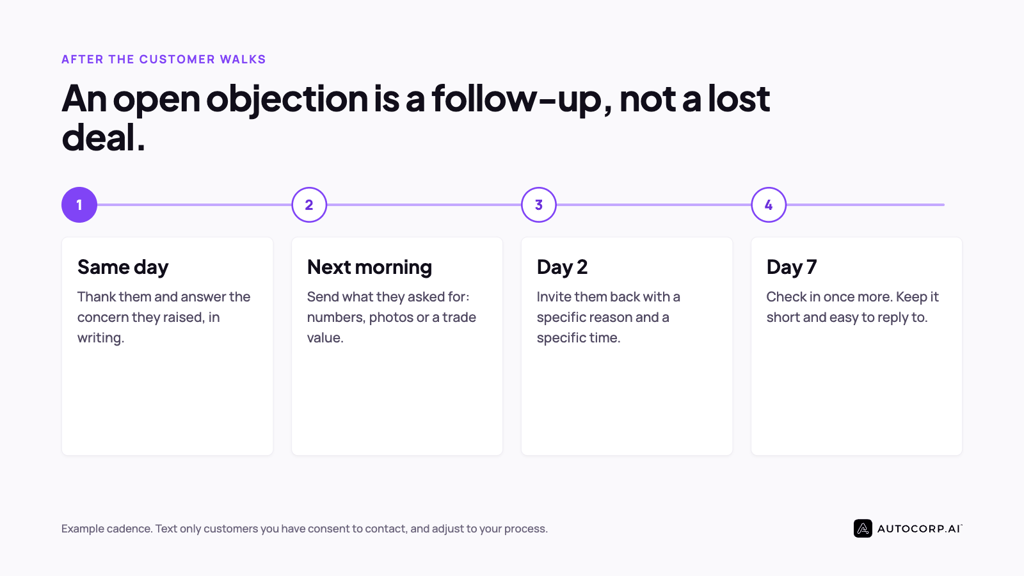
An example four-step follow-up cadence.
Only text customers you have consent to contact, and keep every message short and specific. For the details, see our 7 steps to follow up on leads and these texting do’s and don’ts for dealerships.
Sometimes the close doesn’t happen on the floor. It happens in a text the next morning.
Frequently asked questions
What are the most common car sales objections?
The most common car sales objections are about price, monthly payment, financing approval, trade-in value, trust, and timing. Lines like “the price is too high,” “I need to think about it,” and “I’m just browsing” come up at almost every dealership.
How do you handle objections in car sales?
Use the LAER method: listen without interrupting, acknowledge the concern, explore it with a question to find the real issue, and respond with facts or a clear next step. The explore step matters most, because the first objection often isn’t the real one.
How can dealerships reduce objections at the desk?
Answer budget, credit, and trade questions earlier in the process. When your team knows a customer’s financing picture and trade value before the test drive, fewer price and payment objections reach the desk.
Objections are information, not rejection
Every objection tells you what a customer needs to feel confident. Listen for it, ask about it, and answer the real concern. The dealerships that win aren’t the ones with the slickest rebuttals. They’re the ones that understand their customers early and make the next step easy.
See how AVA® gives your team credit and trade answers before customers have to ask. Book a demo.