 Activix
  AutoTrader
  Black Book
  CarGurus
  Equifax
  TransUnion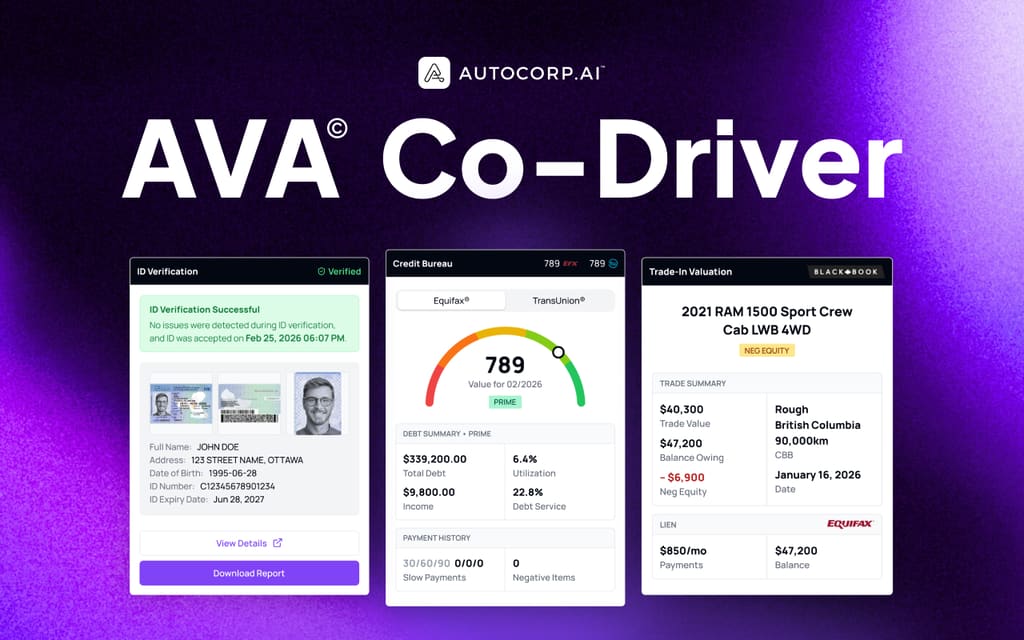



In our experience working with dealerships across Canada, there are four things desk managers, used car managers, and F&I leaders need to evaluate when choosing a trade-in equity detection software:
1. It has to detect equity early — before the customer walks in
Equity position is a qualification, not a courtesy. A subprime buyer with $8,000 in positive equity is often easier to structure than a prime buyer who is $7,000 upside down. If your team doesn't know where the trade sits until the customer is on the desk, you've already wasted the appointment slot, the follow-up cycle, and (usually) the deal.
To detect equity early, you need three inputs stitched together automatically: a market-based valuation on the trade, the customer's payoff/balance owing, and a credit signal to gauge lender appetite. Doing this from a lead form — not a walk-in appraisal — is what changes the calendar.
2. The valuation source has to be one your desk actually trusts
Most managers we talk to have been burned by "instant offer" tools that print retail-optimistic numbers and set up a hard conversation at delivery. From our experience, when the desk doesn't trust the number, the tool gets ignored and appraisals go back to manual — usually a walk-around, a wholesale gut-check, and a 20-minute wait behind the used car manager.
A good equity detection tool should pull valuations from a book your desk already uses (in Canada, that's Canadian Black Book), show wholesale ranges by condition tier, and let you refresh the number as the deal progresses. A range beats a single fake-precise number every time.
3. Equity insight has to live on the lead — not in a separate tab
Say a BDC rep is calling a lead back at 8:03 a.m. and needs to know: what's the trade, what's owed, what's the credit tier, and can we still get to the payment this customer wants?
Most dealerships still solve that by copy-pasting between a valuation tool, the CRM, and a credit portal — three logins, three logs, and often a stale trade number by the time the sales manager sees it. A good equity detection platform should surface trade value, payoff, equity position, and credit range on the same lead record, and flag negative equity as an alert the moment it exists.
4. Equity detection has to plug into inventory and deal structure
Yes, this post is about detecting equity. But a good equity detection tool should also help you act on it — matching the customer to inventory that structures around the equity position and the lender's payment call.
Why? Because knowing a customer is $6,900 upside down isn't the win. The win is finding a unit in your inventory where that $6,900 gets absorbed inside the loan-to-value the lender will approve, at a payment the customer will actually sign. Otherwise you've just detected a reason to lose the deal.
You may wonder: can't I just look this up in my desking software after the customer is here? Yes, but by then you've spent 45 minutes on an appointment that could have been re-directed before it was booked — or paired with a different unit that saves the sale.
After building for and selling to Canadian dealers for years — and living with negative-equity landmines ourselves — we built Autocorp.ai's AVA™ platform to cover all four factors above. Below, we'll walk through how each factor shows up inside the AVA™ Portal, and why desk managers, used car managers, and F&I leaders rely on it to structure deals before the customer arrives.
1. Detect Equity Before the Appointment (Not During It)
We designed AVA™ to capture trade intent at the same moment a shopper hands over their contact info — through the dealer's prequal website, an SMS campaign, or an in-store QR code. When the trade year, make, model, trim, and mileage come in, AVA™ pulls a Black Book range automatically and combines it with the balance owing the customer entered, plus the Equifax soft-pull credit range from the same submission.
The result: by the time the lead lands in your Leads list, the equity position is already computed. You see it on the row.
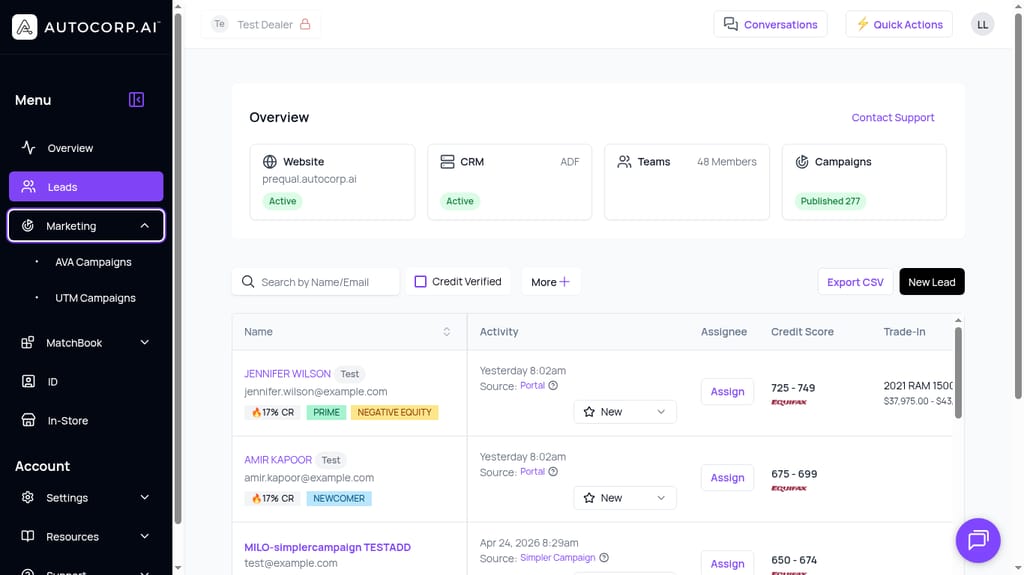
For example, say a BDC lead named Jennifer Wilson comes in overnight. Before anyone picks up the phone, the Leads table already shows a 725–749 credit range (PRIME), a 2021 RAM 1500 trade at $37,975–$43,400, and a yellow NEGATIVE EQUITY tag. Your team knows the shape of the deal before dial one.
That's a very different call from the standard internet-lead call. The rep isn't asking "what are you driving now?" — they're saying "I see you're looking at trading the RAM, and I want to make sure we structure this in a way that works for your payment." Trade objections get handled before they turn into no-shows.
For many dealerships, if you asked the desk to tell you the equity position on every open lead, they'd say "give me a day" and start pulling payoffs and running valuations one by one. In AVA™, that answer lives on the lead list, next to the credit tier — and it refreshes when the customer updates their info or when you pull fresh Black Book data.
That matters because equity is the hidden qualification. Credit tier tells you who a lender will approve. Equity tells you whether the deal will approve. You need both to prioritize the calendar.
2. Trade Values Your Desk Actually Trusts (Powered by Canadian Black Book)
We've sat with used car managers who won't touch a valuation unless it comes from a book they already price against. So we didn't build our own valuation model — we integrated the one Canadian dealers already use.
From our conversations with used car managers and F&I leaders, they don't want a single flashy "instant offer" number that the customer will screenshot and hold you to. They want a range by condition tier, a regional adjustment, and a way to refresh the value when new information comes in (odometer, condition, options).
AVA® reads credit, trade, and ID data and delivers it right where your team works. Take the tour.
Book a demo →Per the below screenshot, AVA™ Trade shows exactly that on every lead:
- Base wholesale value across X-Clean, Clean, and Average condition tiers
- Regional adjustments for the customer's province
- Odometer, mileage impact, and vehicle configuration
- A "Get Latest Trade Data" refresh so the number can be updated as the deal moves
- A visible Black Book data-source badge, so the desk knows where the number came from
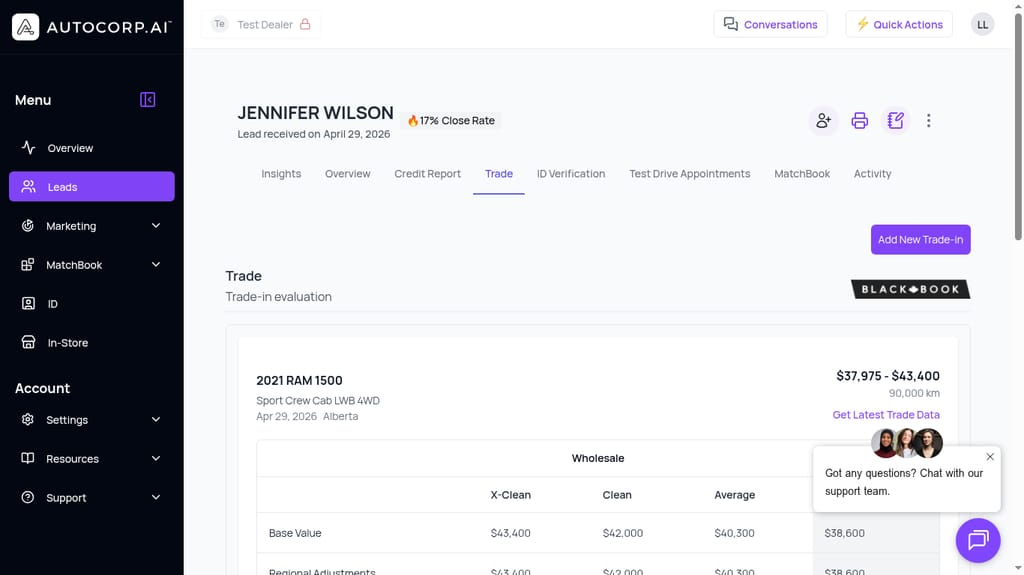
For a used car manager, this is meaningful for two reasons: (1) the customer sees a defensible range instead of a made-up retail number, and (2) the desk gets a value they can actually book against without a second walk-around.
For many dealerships, when a lead asks "what's my trade worth?" the answer is "come in and we'll take a look" — which loses a chunk of shoppers who aren't ready to commit to a visit. In AVA™, the customer gets a market-backed range, the desk gets the same range with wholesale tiers, and both sides walk into the appointment aligned on the number.
Note that the trade record can be updated multiple times per lead — the "Add New Trade-in" button lets you re-appraise as new photos, mileage, or condition notes come in without losing the history on the file.
3. Equity + Credit + Trade on One Lead Record (No More Tab-Hopping)
For most dealerships, credit lives in the bureau portal, valuations live in Black Book, and payoff lives in a note the BDC scribbled down. Answering "what's this deal really look like?" means three logins and a five-minute reconstruction.
But what if you needed to answer a harder question — like "On this specific lead, how much negative equity do we need to absorb, and does the credit tier support burying it?"
That would require a rep to pull the credit report, look up Black Book, subtract the payoff, and mentally compare it to the LTV bands their lenders will approve. Every rep does this differently, and half the time the number ends up wrong.
In the AVA™ portal, that question is answered automatically on the Insights tab of every lead:
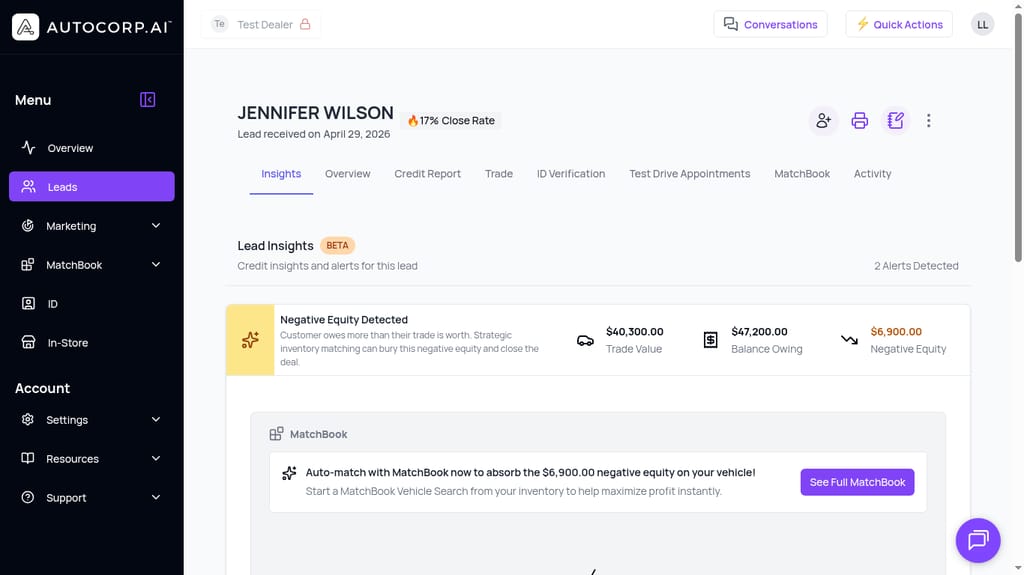
The system shows:
- Trade Value → pulled from Black Book with condition and region context
- Balance Owing → captured from the customer during prequal
- Negative Equity → calculated and highlighted (in this case, $6,900) with a color-coded alert
- Credit tier context → carried over from the Equifax soft pull on the same lead
- Recommended next step → a direct link into MatchBook to find inventory that can absorb the shortfall
That's the whole picture in one glance. The desk doesn't need to "work up" the deal — they can look at the lead, decide it's a subprime-plus-negative-equity situation (or a prime-plus-positive-equity one), and route it to the right salesperson with the right payment strategy.
This is where equity detection stops being a valuation tool and starts being a deal-structuring tool. Positive equity leads get a faster path to upsell and a smarter down-payment conversation. Negative equity leads get realistic expectations and a shortlist of units that will actually fund — before the customer sits down.
For used car managers running multiple rooftops, this is where consistency comes in. Every lead is scored the same way against the same data sources. There's no store where the desk "eyeballs" trades and another store where they book them formally — the process is standardized in the platform.
4. Turn Equity Insight Into Inventory Matches (Without Leaving the Platform)
Yes, you came here for equity detection. But a good equity detection tool should also close the loop into inventory and lender fit — because that's how detection turns into a saved deal instead of a killed one.
That's what AVA™ MatchBook does. Once negative (or positive) equity is on the lead, MatchBook takes the customer's lender approval, credit key, and equity position, and searches your inventory for units where the deal actually structures — surfacing payment, term, interest, frontend profit, and estimated backend for each match.
Now, you may wonder: can't the F&I office just do this once the customer is at the desk? Yes, they can. But by then you've already committed the appointment slot, the sales rep's hour, and (usually) a specific vehicle from the customer's initial inquiry that doesn't actually fit the deal.
With MatchBook wired into the same lead as the equity alert, you flip the sequence: identify the equity gap → find inventory that absorbs it → book the appointment on the right unit → close.
See Equity Detection Live on Your Own Leads
If you want to see what your existing internet leads look like with Black Book trade valuations, payoff-based equity detection, and credit context on the same record — book a demo of AVA™ and we'll walk through it with your team.
We'll show you how AVA™ Trade + Credit + MatchBook work together on a real lead flow, and how used car managers and desk managers use equity signals to structure deals before the appointment is booked — not after.
You can also review the full AVA™ pricing and feature comparison (equity detection is included on AVA™ Growth and MatchBook is included on AVA™ Complete), or read how our platform fits into sales and operations workflows.