 Activix
  AutoTrader
  Black Book
  CarGurus
  Equifax
  TransUnion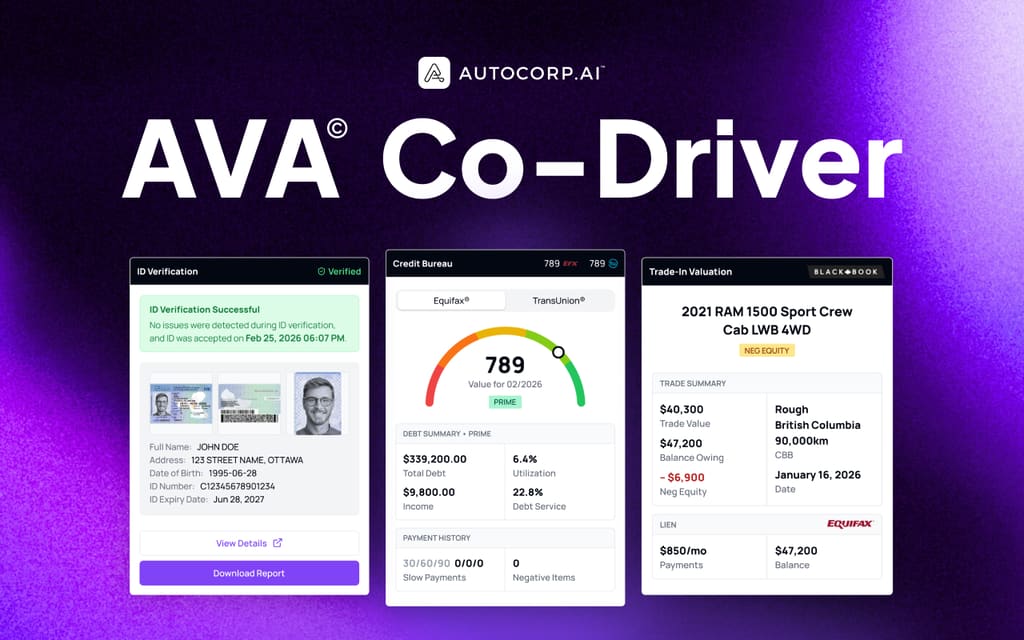



Ask a Sales Manager where the money leaks out of the store, and most will point at ad spend or gross per unit. In our experience working with 650+ dealerships across North America, the real leak is quieter and much bigger: the hours your team burns on leads that were never going to buy.
If 40% of your inbound leads are unqualified, and each rep spends 15 minutes on calls, texts, and CRM notes before figuring that out, a store doing 1,000 leads a month is throwing away roughly 100 rep-hours every month chasing ghosts. At a fully loaded cost of $35/hour, that is $3,500 a month, or $42,000 a year, on follow-up that closes nothing. And that is before you count the deals your team missed because they were busy on the wrong ones.
That is the hidden cost of unqualified leads. Fixing it is what "operational efficiency" actually means for a dealer operations team.
In our experience, there are 4 factors dealership operations leaders need to consider when choosing a platform to run a credit-first, efficient sales floor:
1. Lead qualification has to happen before your team touches the lead
If your BDC or sales floor is the filter, you have already lost the hour. Qualification needs to happen at the form, not at the desk. To do that, you need soft-pull credit, income capture, and a bureau-backed score range attached to the lead the moment it hits your CRM, without impacting the customer's credit.
2. Trade data has to come in with the lead, not get chased down later
Credit tells you who can buy. Trade tells you who actually intends to. A shopper who takes the time to enter their VIN, mileage, and payoff is telling your team they are serious. If your platform captures trade value, balance owing, and equity position at the form, your desk walks into the deal already knowing whether there is $6,900 in negative equity to bury or $8,000 in positive equity to roll into the down payment.
3. Inventory has to match the approval, not the wish list
Getting a soft pull is step one. But what if the salesperson asks: "This customer is approved at $499/month with TD at 84 months. Which of my 240 units actually pencils, and which one makes the most front and back-end profit?"
Most dealers answer that by exporting the inventory feed to a spreadsheet, calling the lender rep, and guessing at reserve and backend. A good operations platform should map lender approvals to VIN-level inventory automatically and show payment, term, frontend profit, and estimated available backend on every unit, so the desk stops guessing.
4. Your platform has to talk to your DMS, not sit beside it
Yes, this article is about lead operations. But a good dealer operations platform should also push clean data into your DMS and pull inventory back out, so the credit app, the trade, the ID, and the deal jacket all live on the same customer record. Why? Because every re-key is a chance for error, a delay, and a lost handoff between sales and F&I. You may wonder, can't the CRM handle this? Sometimes, but the credit and trade data usually sit in a third tool, which means your F&I manager is toggling between four windows to structure a deal. Consolidating the credit, trade, ID, and MatchBook data into the DMS record removes that toggle tax.
After years of building tools for dealers (and being dealers ourselves), we built the AVA® Platform to close each of these four leaks. Below is how each product maps to the factor it fixes, and the real ROI numbers we see from stores running the PBS integration.
Factor 1: Qualify Leads Before the First Call With AVA® Credit
The hidden cost of an unqualified lead is not the lead itself. It is the 15 minutes your rep spends before finding out the customer has a 520 score and $1,900 in monthly income. Multiply that by the 400 unqualified leads in a 1,000-lead month and you have burned two full-time weeks of headcount.
AVA® Credit fixes this at the form. When a shopper fills out the credit application on your website (a four-step, bilingual form), the soft pull runs in seconds through Equifax, and the lead lands in the AVA® Portal already tagged with a credit score range, tier (Prime, Near-Prime, Subprime), income, and any deal-blocking flags.
For the leads that come in without completing the form, we recently added a TransUnion dealer-initiated soft pull. Your team can run a bureau-backed soft pull on any lead in the portal once the customer provides consent (verbal consent captured on a recorded call, or a quick consent link texted to the customer). Once consent is on file, the pull runs on just a name, address, and date of birth. That means the phone-up who left three fields blank, the walk-in who filled out a paper card, and the AutoTrader lead that skipped your credit widget all get qualified before the first call back, as long as you have their consent. Equifax stays the primary consumer-facing pull on the website form; TransUnion covers the leads that would otherwise sit in your CRM unqualified for a week.
Your team stops calling to qualify. They call to sell.
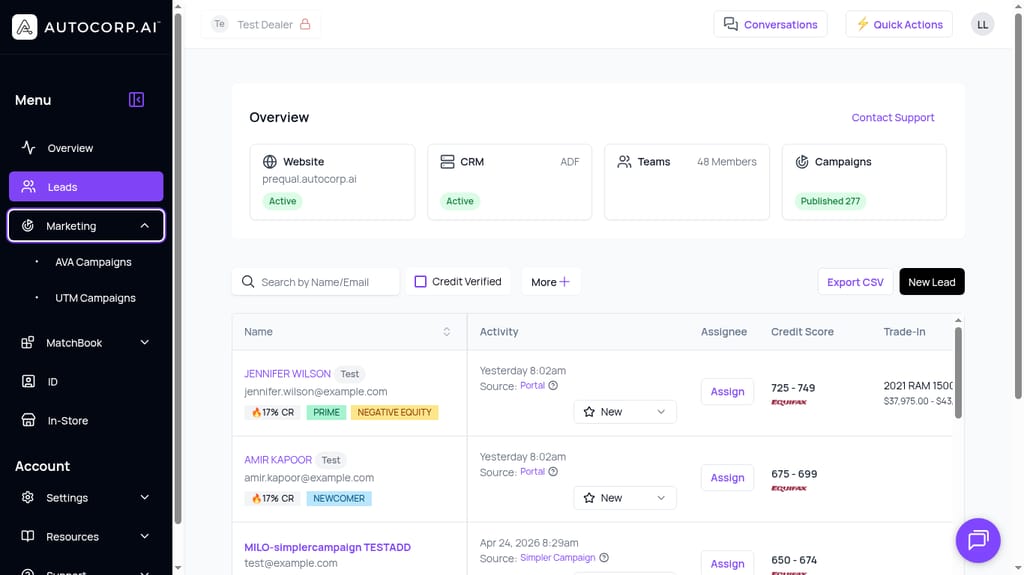
For example, say a Sales Manager opens Monday morning and there are 47 new leads in the queue. Instead of assigning them in order received, they flip on the "Credit Verified" filter at the top of the Leads table. Now the queue shows only the leads who have a bureau-backed score attached, sorted by credit tier. The 725 Prime buyer with a 2021 RAM 1500 trade goes to the top rep. The 550 subprime file gets routed to the specialist who runs the subprime desk. The rest go into a nurture SMS campaign, which includes a consent link so TransUnion pulls can run as customers reply.
That took 90 seconds. Without AVA® Credit, that same triage takes a rep the entire morning of dialing, and it still misses the tier signals.
The bureau data comes with Equifax or TransUnion branding on the lead card, so your F&I team trusts the number when it hits the desk. There is no re-pull, no re-work, and no customer sitting in the showroom for an hour while you wait for a hard pull to come back.
Factor 2: Capture Trade Intent at the Form With AVA® Trade
A credit score tells you the customer can buy. A trade-in submission tells you they plan to. When a shopper takes 90 seconds to enter their VIN, mileage, and lienholder, they are telling your team they are already thinking about the transaction, not just browsing.
AVA® vous dit qui est prêt à acheter avant même que votre équipe lève le petit doigt. Voyez le flux.
Réserver une démo →AVA® Trade sits on your website next to the credit application and captures three things your desk needs before the first call: the real market value of the trade (backed by Canadian Black Book), the balance owing on any active lien, and the equity position (positive or negative).
That last piece is the one that changes how your team runs the deal. Take a lead like Jennifer Wilson. Her trade comes in with a value of $40,300 and a balance owing of $47,200. That is $6,900 in negative equity, and it hits the lead card the same minute the credit score does.
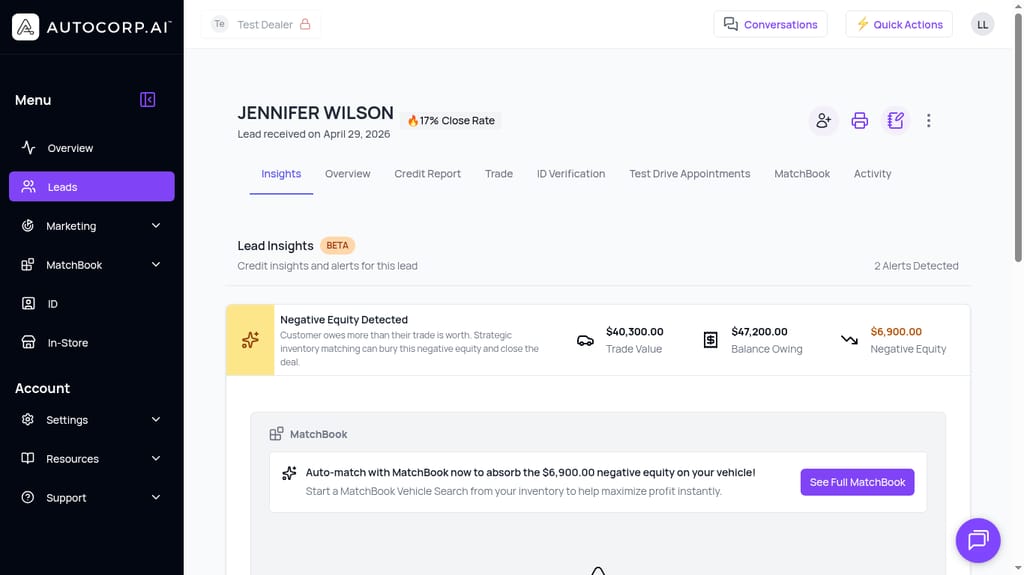
Without that data, your rep calls Jennifer, quotes her a payment on a $45,000 truck, and gets ghosted when the numbers do not work. With that data, your rep skips the payment quote entirely and pivots the conversation: "We can absorb that $6,900 with the right unit. Let me pull three options." That is a deal that closes instead of a lead that goes cold.
Trade data also feeds the equity mining campaigns in the AVA® Portal. Any customer with positive equity in your CRM gets flagged for an SMS outreach when a new-vehicle model they might upgrade to lands on your lot. Your operations team stops relying on memory to work the service database.
Factor 3: Match Approvals to Inventory Instantly With AVA® MatchBook
Here is the scenario every desk manager knows. A customer is pre-approved at TD Auto Finance, 4 Key, $499/month, 84 months. Sales walks over with a spec sheet and says: "What can I put them in?"
The old answer takes 30 to 90 minutes. Somebody pulls the inventory report, somebody else pulls the lender's max advance, somebody guesses at reserve, and the F&I manager back-solves the deal on a legal pad. By the time the numbers come back, the customer is texting a competitor.
AVA® MatchBook does this in one screen. You pull the customer's lender approval into MatchBook, and the platform returns every unit in your inventory that fits the approval, with the deal already built.
For example, load a customer with a $499 payment target and a $7,000 negative equity position. MatchBook returns the fit list:
- 2021 Mazda 3 GT Turbo at TD Auto Finance, 4 Key: $499.07/month, 14.00% APR, 84 months, cash price $18,480, frontend profit $1,280, estimated available backend $3,696.
- 2021 Mazda CX-3 GS at TD Auto Finance, 4 Key: $518.78/month, 14.00% APR, 78 months, cash price $18,340, frontend profit $940, estimated available backend $3,668.
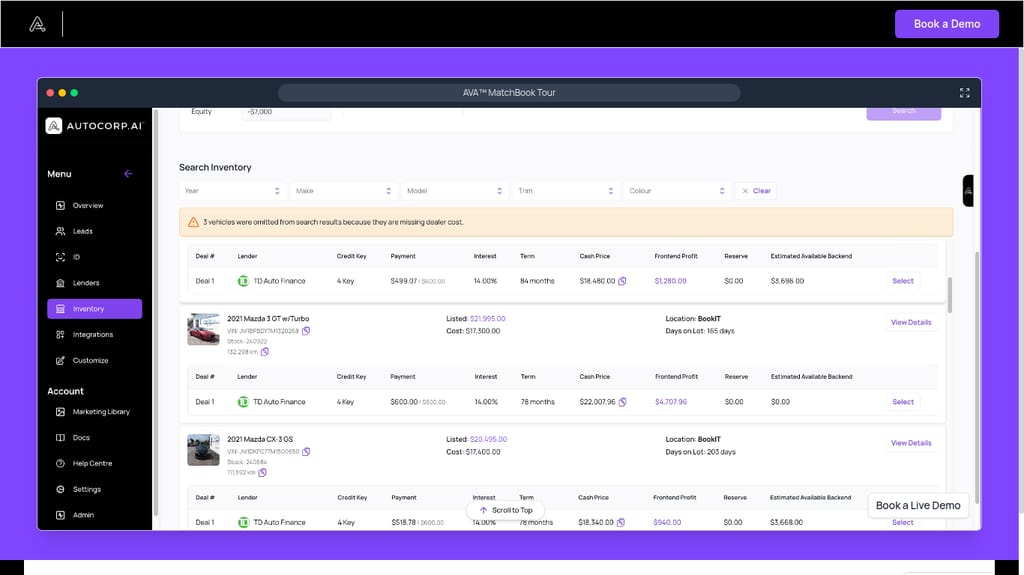
Two clicks, and the desk knows which unit maximizes gross for a customer already sitting inside the approval. Notice that MatchBook flags vehicles missing dealer cost and removes them from the results, so you never quote a deal built on incomplete data.
The efficiency gain compounds. If your store does 50 deliveries a month and MatchBook saves your desk 30 minutes on structuring each deal, that is 25 hours a month back to your F&I manager. At AVA® Complete pricing, MatchBook pays for itself before the first month closes.
Factor 4: Push Clean Data Into Your DMS With the PBS Integration
Yes, most of this article is about lead qualification. But dealer operations lives or dies on the handoff between sales, F&I, and accounting. If the credit, ID, trade, and MatchBook deal all live in AVA® but your deal jacket lives in PBS, somebody is re-keying customer data three times per deal.
The AVA®/PBS integration removes that re-key. Lead delivery and customer data sync automatically between the AVA® Portal and PBS CRM. Soft-pull credit (Equifax or TransUnion), ID verification, trade valuation, and MatchBook deal structure ride along with the customer record, so when your F&I manager opens the PBS deal jacket, the file is already built.
Now, you may wonder, can we just live in the DMS? You can, but the DMS was not designed to run a soft-pull credit workflow, capture a bureau-branded score range at the website form, or return VIN-level lender-matched deal structures. Living only in the DMS means your team keeps re-keying credit and trade data from a third tool, which is exactly the toggle tax we started with.
The revenue math on consolidating this workflow shows up on the AVA® pricing page. For a store running 500 leads a month, $2,500 average front-end profit, and 50 monthly car sales, the platform models:
- +25% lead volume (625 monthly leads)
- +15% profit per vehicle ($2,875 average)
- +25% monthly sales (63 vehicles)
- $93,750 in additional monthly revenue
- $1,125,000 in additional annual revenue
Those numbers are not hypothetical. They come from the conversion lift we see when credit-qualified leads replace raw internet leads on the sales floor.
Push that data cleanly into PBS via the PBS integration, and your operations team stops fighting the tools and starts running the store.
See What Operational Efficiency Looks Like on Your Floor
For a full breakdown of how the AVA® Platform closes each of the four profitability leaks above, visit our pricing and ROI calculator, or book a demo and we will walk you through your store's numbers.