 Activix
  AutoTrader
  Black Book
  CarGurus
  Equifax
  TransUnion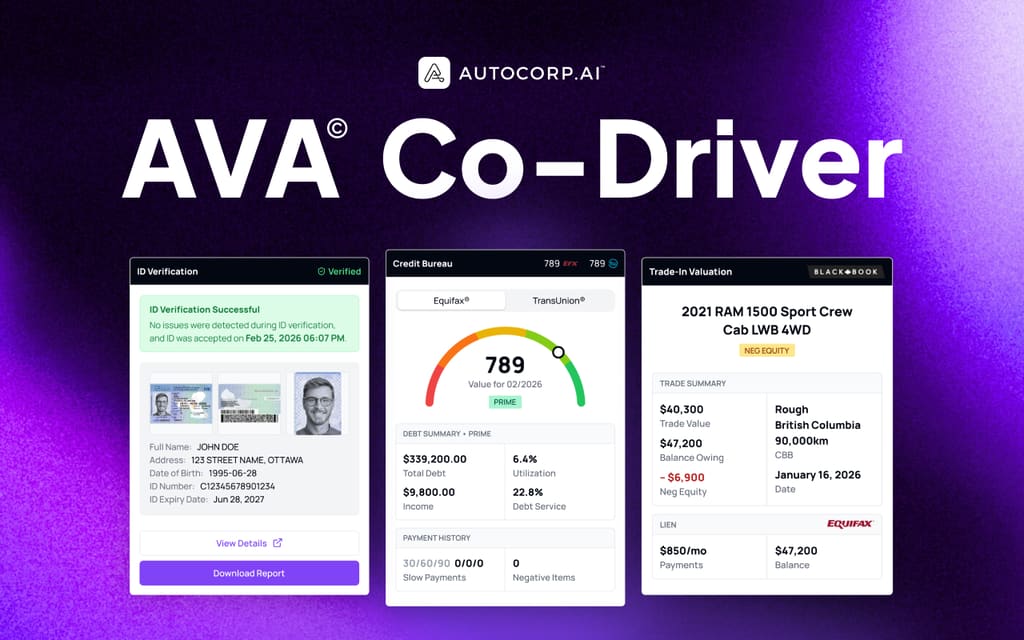


"Honestly, we usually don't know until finance."
That's a sales manager we spoke with describing his team's lead follow-up process. Five calls, five emails, a couple of videos, a test drive — and they still didn't know whether the buyer they spent two weeks on could be approved until the customer was sitting in the F&I office. Then the deal blew up over a 580 score, negative equity on a trade nobody asked about, or a stip the bank wouldn't waive.
If that sounds like your store, the problem isn't the seven-step follow-up cadence everyone teaches. The cadence is fine. The problem is you're following up on anonymous leads — a name, a phone, maybe an email — and trying to guess your way to a sold unit.
This is a refresh of the old playbook. Same seven steps, reordered around one shift: get the credit profile before you pick up the phone. Once a rep knows whether they're talking to a prime buyer, a subprime buyer, or a newcomer to Canada, every message, every call, and every appointment changes. The 30-day cadence stops being a fishing trip and starts being a structured close.
Here's the credit-first version.
Step 1 — Start with the credit profile, not the phone
The old advice was "respond in five minutes." Good advice, still true, but incomplete. Responding fast to an unqualified lead just means you waste your fastest response on someone who can't get bought.
Before the first call, the BDC rep should be able to see:
- Credit score band (prime, near-prime, subprime, deep subprime)
- Income range
- Total debt and debt utilization
- Whether the lead is a newcomer to Canada
- Trade-in details, if any
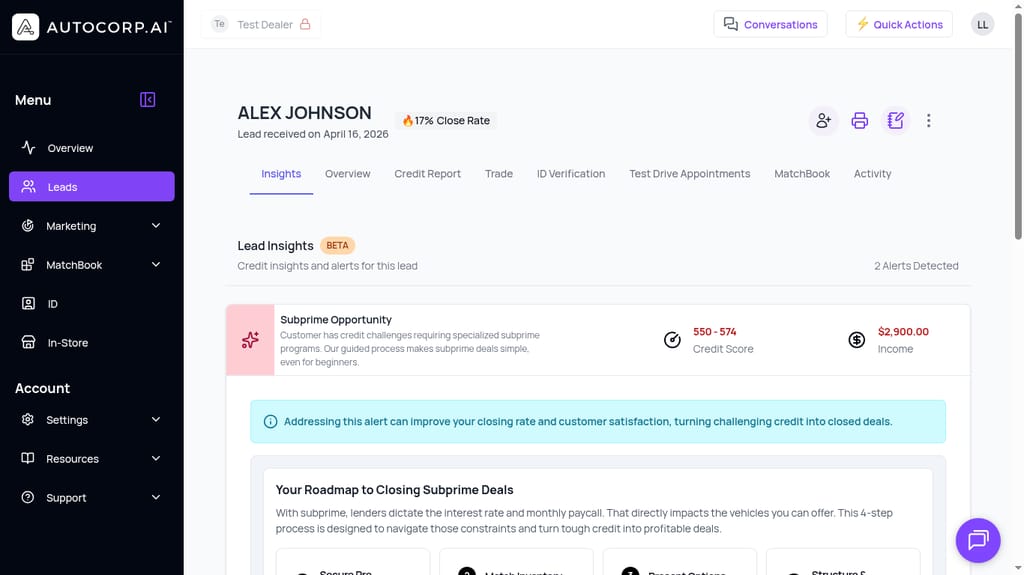
Inside the AVA™ Portal, this lives on the Lead Insights (BETA) tab on every lead record. When a lead comes through the website credit form, AVA™ pulls a soft credit snapshot via Equifax and tags the lead with the buyer profile — for example, an alert that reads "Subprime Opportunity" with a score range of 550–574 and income of $2,900/month, or a "Newcomer Suspected" flag with bureau age and credit file thickness.
That one screen tells the rep how to open the call. It also tells them which leads to call first, which we'll get to in Step 3.
If you want the longer version of why this matters, we wrote it up here: The Difference Between an Internet Lead and a Credit Qualified Lead.
Step 2 — Segment your follow-up by credit reality
Not every lead deserves the same playbook. A prime buyer with a 740 score and clean trade equity needs a different conversation than a subprime customer with $2,900/month income, and both need a different conversation than a newcomer with two years of bureau history and zero open trades.
Here's how we'd split the day's follow-up list:
Prime (700+). Lead with inventory and payment. They already know they can be approved; what they want is the right unit and a fair number. Talk model, trim, delivery timeline, and trade value. Don't bury the lede in financing.
Subprime (sub-650). Lead with the program, not the car. The lender controls the rate and the monthly paycall, which controls the vehicle. The conversation needs to be: "We have a program that will get you approved — let's confirm a few details, then I'll match you to a vehicle that fits the approval." Anything else and you'll spend three days showing them a truck they can't get bought on.
Newcomers. Lead with the path. New-to-Canada programs exist at most major lenders, but they require documentation (work permit, proof of income, sometimes a co-signer). A newcomer with a 34-year-old applicant, software engineer occupation, and 2 years of bureau history (a real example from the AVA™ Portal) doesn't need a "test drive Saturday?" text — they need to know which lender program they qualify for.
No credit pulled yet. This is the bucket where the old seven steps still apply, with one addition: get the soft pull done before you spend more energy. (More on that in Step 4.)
Tag the leads in your CRM or in AVA™'s lead list so the team can sort by tier (PRIME, NEAR-PRIME, SUBPRIME, NEWCOMER, NEGATIVE EQUITY) and work the right buckets at the right time of day.
Step 3 — Respond fast — to the finance-ready leads first
Speed-to-lead is the single most cited follow-up metric in this industry, and the data is harder than most people realize. The Lead Response Management Study (Oldroyd, MIT/InsideSales, summarized in Harvard Business Review, 2011) analyzed 15,000 leads across 100,000 call attempts and found that contacting a lead within 5 minutes made you 21 times more likely to qualify it than waiting 30 minutes. Separate research from Lead Connect puts a finer point on it: 78% of customers buy from the dealership that responds first.
That's the case for speed in general. Here's the credit-first twist: respond fastest to the leads that already have a credit profile attached. Autocorp's own data on credit-checked buyers shows they're 15–20% more likely to buy and convert at roughly 5–7x the rate of typical internet leads (source). A prime or near-prime lead with a soft pull in hand is closer to a sold unit at minute zero than an unqualified internet lead is at minute sixty. As one finance manager put it when we asked about prioritization: "Follow up quickly on the buyers who genuinely need financing — those are the ones who'll show up."
A practical rule:
- Credit-qualified leads (soft pull complete, score band visible): respond within 5 minutes, by phone.
- Trade + credit together: same urgency — these are your hottest leads, see Step 6.
- Anonymous internet leads (no credit yet): respond within 15 minutes, but the purpose of the first message is different — see Step 4.
The point isn't to ignore unqualified leads. The point is to stop treating them identically to leads where you already know the buying power.
Step 4 — Make the first message a value exchange: a no-impact pre-approval
For the leads that came in without a credit profile, the first text or email shouldn't be "Hi, this is Mike from the dealership, when can you come in?" That message gets ignored because it asks for something (the customer's time) without offering anything.
Trade that for a value exchange:
"Hi Chris — Mike here at [Dealership]. Before you come in, want to see what you're approved for? It's an Equifax soft pull, takes about 90 seconds, and won't affect your credit score. Here's the link."
A few reasons this works better than a standard follow-up text:
AVA® surfaces soft-pull credit, trade equity, and verified ID on every lead. Take the 60-second tour.
Book a demo →- It gives the customer something they actually want (a real number they can plan around).
- It pulls them deeper into the funnel without asking them to drive anywhere.
- It tells you who's serious. A buyer who finishes a credit form is materially more committed than one who replies "just looking."
- It prevents the F&I surprise. We've all watched deals fall apart at the desk because the customer's credit picture wasn't what the rep assumed. Surface it now, not on delivery day.
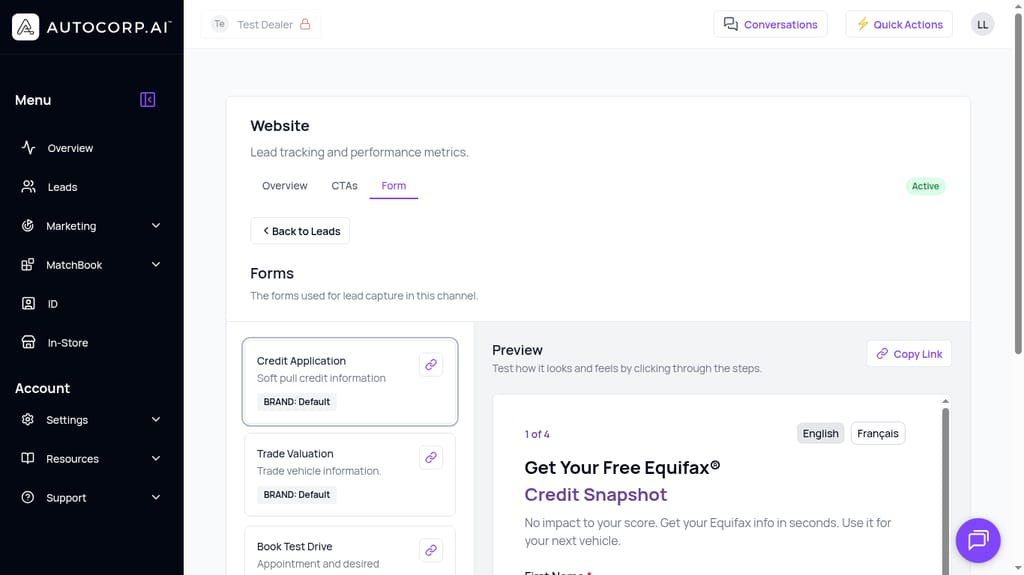
The AVA™ Credit soft-pull form is bilingual (English/Français) and feeds the result straight back into the lead record so the rep sees the score band, debt utilization, and income on the same screen they're working from. There's more detail on how AVA™ Credit works for dealership financing on the Automotive Dealership solutions page.
Step 5 — Re-engage dead and unsold leads with credit-linked SMS, and tag for attribution
Most BDC managers we talk to have the same dead-lead problem: thousands of names in the CRM, last touched 30, 60, 180 days ago, and no good reason to call them. The script — "Hey, still looking for a vehicle?" — has been burned out for years.
A credit-anchored SMS works because it gives the customer a reason to come back, and it gives the rep a reason to call:
"Hey Sarah — rates moved this month. Want a quick re-check on what you'd be approved for today? No impact to your score."
One of the sales managers we interviewed described the play simply: "[SMS is] a way to get them back to engaging with you." Most of these customers aren't dead — they just stalled. A new credit snapshot is a legitimate reason to restart the conversation.
A few things to get right:
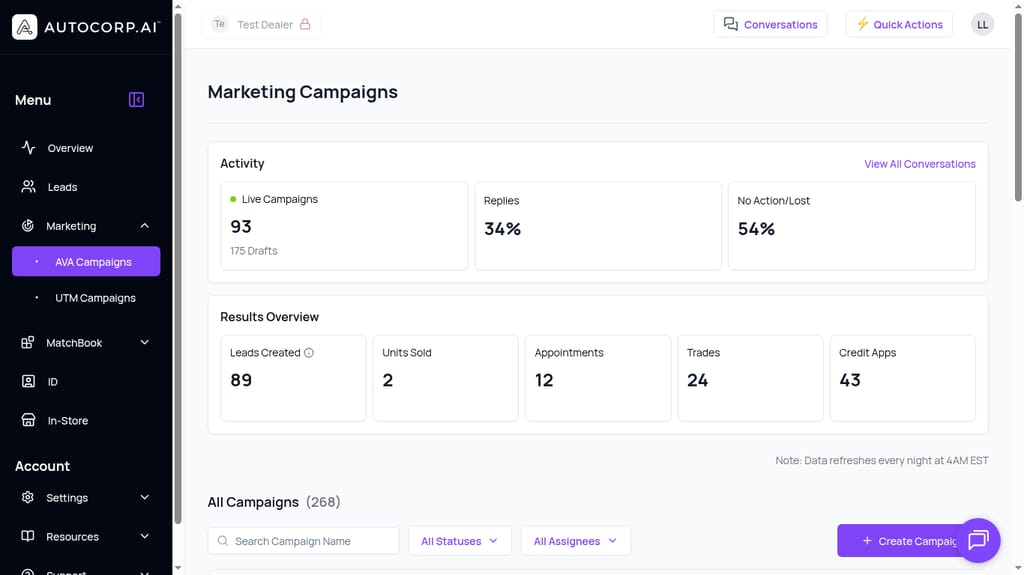
- Send from a tracked number or campaign. Inside AVA™ Campaigns, every reply lands in the Conversations inbox tied to the original campaign tag, so when the customer re-engages you can see exactly which message brought them back. (The Campaigns dashboard surfaces this as Replies %, Leads Created, Credit Apps, Appointments, and Units Sold so you can see what's working.)
- Tag the returning lead. If they fill out the credit form a second time, the lead record should attribute the close back to the SMS that woke them up — not to the original web form from six months ago. This is how you actually measure re-engagement.
- Don't blast. Segment by credit tier and trade situation. A negative-equity owner gets a different message ("rates dropped — let's see if we can restructure") than a paid-off owner.
If your in-store traffic is also slipping through without getting captured, the same logic applies to floor ups and service customers. We covered the QR-code-driven version of that here: Automotive Marketing tools and in-store capture.
Step 6 — Read the buying signals credit gives you (trade + credit = "really hot")
The single strongest buying signal we see in dealer data is a customer who completes both a trade valuation and a credit application in the same session. As one of our dealer partners put it bluntly when describing this combination: "When we see trade plus credit together, this is really hot."
Here's why: a trade-in submission tells you the customer is mentally past "researching" and into "structuring a deal." A credit pull tells you they're willing to be evaluated as a buyer. Together they mean the customer has decided — they're shopping for the right offer, not the right dealership.
What to do with that lead:
- Call within five minutes. Not text — phone.
- Open with both pieces of data: "I see you're looking at the Tucson and you have a 2021 RAM 1500 to trade. I pulled the book value and it's coming in around $37,975 — $43,xxx. Let me walk you through what that means for the deal."
- Acknowledge negative equity upfront if it's there. Don't wait for finance to surface it.
- Use a tool like AVA™ MatchBook to match the approval to inventory the buyer can actually be funded on — especially important if there's negative equity to bury or a subprime program with paycall limits.
A "PRIME / NEGATIVE EQUITY" tag on a lead is not a problem; it's a roadmap. You know the customer can be approved, you know there's a structuring conversation coming, and you know to pull the F&I manager in early instead of at the end.
Step 7 — Track follow-up all the way to the sold unit
This is the step most follow-up articles leave out, and it's the one that matters most to anyone responsible for BDC ROI.
If your follow-up reporting stops at "appointments set" or "leads contacted," you don't actually know what's working. You know what's busy. The metric that matters is attribution from lead source → first touch → credit pull → appointment → sold unit.
A few things to put in place:
- Tag the source on every lead. Website credit form, marketing campaign, walk-in QR code, third-party marketplace — each lead should carry its origin into the CRM.
- Track credit pulls as a stage, not a side action. A lead that completed a soft pull is a different stage than a lead that didn't. Your funnel report should reflect that.
- Close the loop to "Units Sold." The AVA™ Campaigns dashboard, for example, surfaces Leads Created, Credit Apps, Appointments, Trades, and Units Sold for each campaign. Whatever tool you use, the funnel needs to end at the sold unit, not at the appointment.
- Review weekly with the BDC team. Which sources drive credit-qualified leads? Which reps convert subprime at the highest rate? Where does the funnel leak — between credit pull and appointment, or between appointment and sold?
Once you have this view, the monthly conversation with your GM stops being "we made a lot of calls this month" and starts being "we sold 14 units this month from credit-qualified leads, average front-end gross of $X, average days from first touch to delivery of Y." That's the report that gets follow-up tooling approved in next year's budget.
The honest version
The old seven-step follow-up worked when the customer journey was: drive past the lot → call the dealership → come in on Saturday. It does not work when the customer has already configured the car on the OEM site, checked their credit on a fintech app, and submitted forms at four dealerships before yours.
For context on how steep the baseline is: the average dealership converts only 2–5% of internet leads into sold units, according to Ruler Analytics' 2025 benchmarks — and Foureyes' 2025 industry report found that 43% of qualified leads were mishandled (never logged, missed calls, or delayed follow-up). Most of that loss isn't a lead-quality problem. It's a triage problem.
Credit-first follow-up doesn't replace the fundamentals — speed, personalization, multiple touches, video, all of it still applies. It just stops you from running those plays blind. When the rep already knows whether they're talking to a prime buyer with equity, a subprime customer who needs program-first conversation, or a newcomer who needs documentation guidance, the cadence collapses from 30 days of guessing into a structured close.
And the F&I surprises — the deals that fall apart at the desk because the credit picture wasn't what anyone assumed — start happening a lot less.
See what your follow-up looks like when every lead comes with a credit profile
If you want to see what your own follow-up list looks like with credit, trade, and ID signals attached to each lead, the easiest way is to run it on your own data. Book a working session and we'll walk through it with your team — no slide decks, just your leads.