 Activix
  AutoTrader
  Black Book
  CarGurus
  Equifax
  TransUnion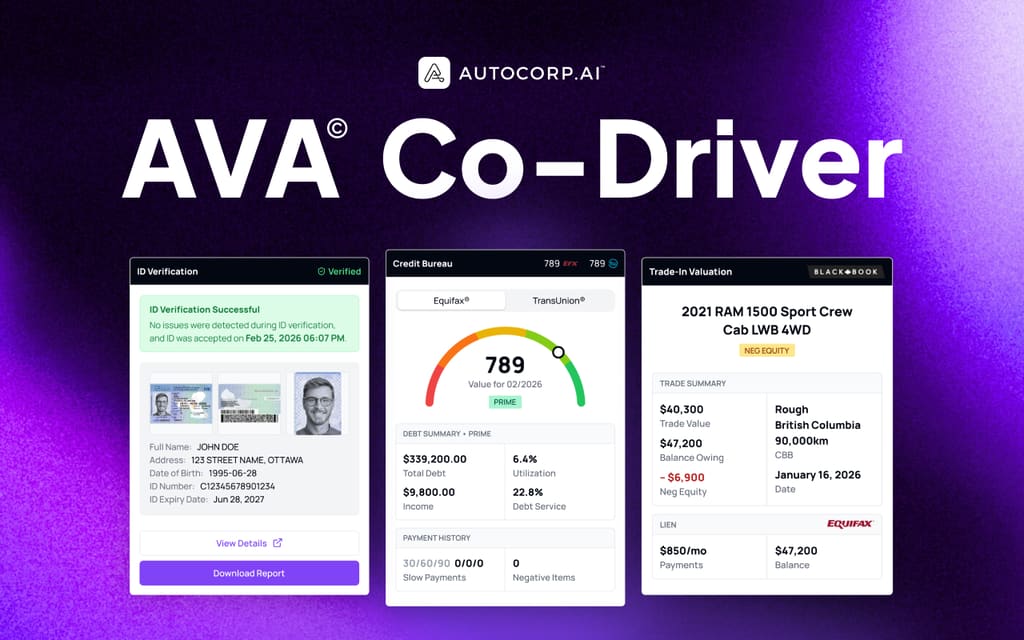


.jpg)
Most price negotiations at your store are already over before the customer sits down. They've spent hours on AutoTrader, watched three YouTube videos about "dealer tricks," and screenshot the KBB estimate for their 2019 Civic. By the time they walk in, they've decided what the numbers should look like, and your job is either to confirm it or fight them for two hours to move the deal a few hundred dollars.
There's a shorter path. Instead of hiding the Canadian Black Book number until the desk drops it on them, put that number in the customer's hands before the negotiation starts. Yes, it feels like a stomach punch the first time you try it. You're voluntarily giving up leverage. But what you get back is a customer who stops arguing about price and starts talking about payment, term, and trade equity.
That's the shift this article is about, and it's the reason AVA® Trade is built on Canadian Black Book data instead of a proprietary "dealer number" nobody trusts.
Key Takeaways
- Canadian Black Book values reflect real Canadian transaction data by region, condition, and trim, so both sides are working from the same source of truth.
- Handing the customer the CBB range early kills the "you're lowballing me" objection before it starts, because you're not the one who set the number.
- Trade objections shrink when the offer is tied to a wholesale range, regional adjustment, and condition tier the customer can see for themselves.
- Online pricing that lines up with Canadian Black Book brings you more qualified leads and fewer surprise walkouts on the showroom floor.
- AVA® Trade puts the Black Book range in front of the customer during the lead form, so your desk starts the conversation 30 minutes ahead of where it used to.
Why Hiding the Number Stopped Working
For years, the playbook was to keep valuation opaque. If the customer didn't know what their trade was worth, you had room to move. If they didn't know what the vehicle actually retailed for, you could hold gross.
That playbook broke when phones showed up in the sales office. Canadian Black Book values, MMR data, dealer invoice estimates, and comparable listings from every other lot within 500 kilometres are all one tap away. When you quote a number that doesn't line up with what the customer already saw online, you don't win the negotiation. You lose trust, and often the deal.
Canadian Black Book is the industry benchmark in Canada for a reason. It's built on actual transaction data, adjusted for provincial demand, mileage, condition, and trim. So the question isn't whether the customer will find a CBB number. It's whether they'll find it from you, or from a competitor's trade tool.

The Stomach Punch: Show the Price First
Here's the part that makes sales managers uncomfortable. When a lead lands on your website and provides their VIN or plate, the ideal experience is not "thanks, a rep will call you." The ideal experience is a real Black Book valuation range on their screen, right now, before anyone from your dealership picks up the phone.
That feels like giving away leverage. In practice, it does three things:
- It filters out tire-kickers. Someone who sees a real range and books an appointment anyway is a buyer.
- It resets expectations before your salesperson is in the room. The customer has already absorbed the number and adjusted their emotional attachment to it.
- It makes your dealership the source of the honest answer, not the villain trying to hide it.
Every objection your team fights on the floor about trade value is an objection the customer formed sitting in your parking lot, not one you started with. Show the number first and you get to skip the fight.
What AVA® Trade Actually Shows the Customer and the Desk
AVA® Trade pulls Canadian Black Book data directly into the customer-facing form and into the lead record your sales team sees. Two examples of what that looks like inside the AVA® Portal:
- A valuation range, not a single number. For a 2021 RAM 1500 Sport Crew Cab at 90,000 km in Alberta, the record shows a $37,975 to $43,400 wholesale range with a BLACK BOOK badge next to it. The customer sees the range. Your desk sees the range. Nobody is inventing a number.
- Condition tiers side by side. X-Clean, Clean, and Average columns are visible with the base value for each. When the customer says their truck is "mint," you have a clean way to walk through why the Clean column applies and the X-Clean number doesn't.
- Regional adjustments broken out as a line item. Not a mystery discount. An actual row on the appraisal that reflects what that vehicle is worth in that province today.
- A "Get Latest Trade Data" refresh for when the deal sits for a few days and the market moves. Nobody gets stuck arguing against a stale number.
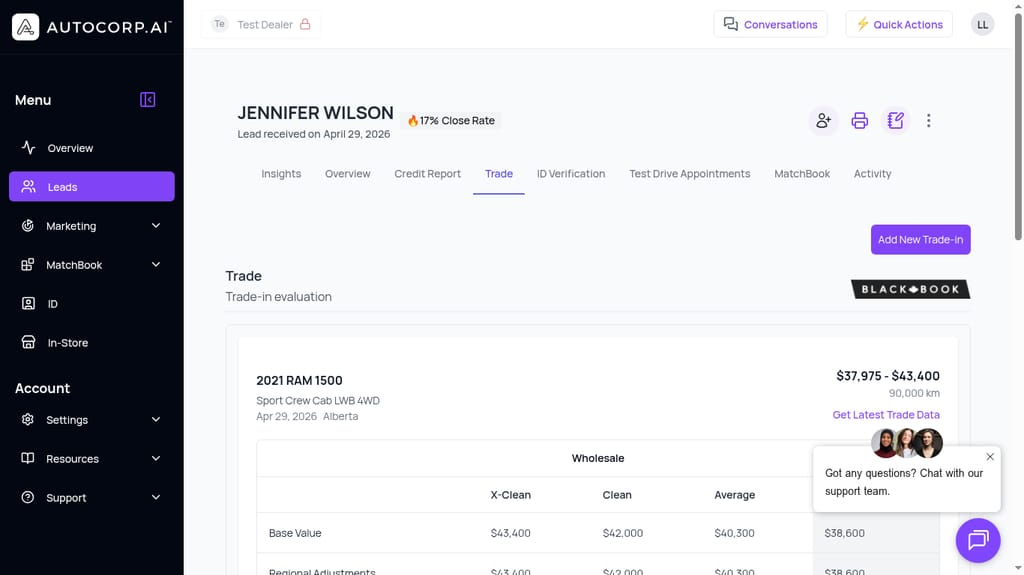
The point isn't the screenshot. The point is that when the customer sees the same wholesale range, the same condition columns, and the same regional adjustment that your used car manager is looking at, there's nothing left to argue about except the appraisal of condition. And that's a conversation, not a negotiation.
Handling the Four Objections You'll Actually Hear
Transparency doesn't remove objections. It changes which ones you get. Here are the ones that come up most often once CBB data is in the customer's hands, and how to work through them.
"KBB says my trade is worth $4,000 more."
Kelley Blue Book is a U.S. book. Canadian Black Book uses Canadian transaction data, which is what any Canadian lender or wholesaler will actually pay. Point at the regional adjustment line. That's the difference.
"I saw the same truck listed for $46,000 down the street."
That's a retail asking price on a competitor's lot, not a sold price and not a wholesale trade. Walk through the difference between what a store lists a unit for, what it sells for, and what they'd offer on trade against a new unit. The CBB wholesale column makes this concrete.
"Why is my condition 'Clean' and not 'X-Clean'?"
This is the good objection. It means you're negotiating condition, not existence of value. Walk the vehicle with them. Point to the tire wear, the interior, the service history gap. X-Clean is a specific standard. Most trades don't hit it, and now you have language to explain why.
"The number changed from what I saw online."
Two possibilities: the market moved (hit refresh, show the new pull), or the walk-around uncovered condition items the online form didn't capture. Both are honest conversations to have.
Trade-Ins With Negative Equity Get Easier, Not Harder
AVA® tells you who's ready to buy before your team lifts a finger. See the workflow.
Book a demo →The hardest trade conversation is the one where the customer owes more than the vehicle is worth. If they don't know that going in, you're delivering bad news cold at the desk. If they see the Black Book range on your website, and your form has already pulled their lien balance through AVA® Trade's lien matching and equity detection, the negative equity is a fact on the screen when your BDR calls them, not a surprise in your finance office.
Sales Manager Dan doesn't want to spend 40 minutes talking a customer off the ceiling because the payoff on their Rogue is $6,000 more than the trade. He wants the customer to already know that when they book the appointment, and to arrive ready to talk about how to roll it into the new deal. That's exactly what surfacing the equity picture upfront does.
This ties back to what a Credit-Qualified Lead actually is at Autocorp. Not just a name and a phone number, but a lead where credit tier, trade value, remaining balance, and equity position are all visible before the first outbound call.
Aligning Online Pricing With CBB Numbers
Trade is one side of the negotiation. Your inventory pricing is the other. If your lot listings sit noticeably above CBB retail benchmarks for the same year, trim, and mileage in your region, you're paying for clicks that turn into "just checking" leads. If they sit close to CBB retail, you're pulling in shoppers who've already accepted the market.
A useful discipline is to pull the CBB retail range on any unit that's been on the lot more than 45 days and ask: is our price defensible against this number, or are we asking the market to be wrong? The answer often points to a price move that would have paid for itself twice over in reduced days-to-turn.
What This Changes for the Sales Manager
If you're running the floor, the practical shift is this. Your salespeople stop opening trade conversations with "let me take a look and see what we can do." They open with "I see you've already seen the Black Book range on your Sierra. Let's walk it together so we can nail down which condition tier applies." That's a completely different starting position. It's collaborative, and it doesn't burn 25 minutes on posturing.
The other shift is at the desk. When the customer already has the CBB range in their head, your desk doesn't have to defend a number. They have to explain any variance from it. That's a much shorter conversation, and it's why dealerships using AVA® Trade report shorter times-in-store and higher close rates on trade-heavy deals.
The Compounding Effect
Every step where a customer feels like the number came from a shared source, instead of from your side of the desk, is a step where trust goes up and time-to-close goes down. Canadian Black Book is that shared source. AVA® Trade is how you put it in front of the customer at the lead stage, tie it to their credit profile and lien balance, and hand it to your sales team with everything they need to run a clean deal.
You're not giving up leverage. You're trading the leverage of ambiguity, which the internet has already taken from you, for the leverage of credibility, which is the only kind left worth having.
Want to see what AVA® Trade looks like plugged into your website? Book a demo or compare plans to see where AVA® Trade fits.
Frequently Asked Questions
What is Canadian Black Book and why do Canadian dealers use it over KBB?
Canadian Black Book is a valuation source built on Canadian transaction data, regional demand patterns, and Canadian lender behaviour. Kelley Blue Book is a U.S. book that doesn't reflect what Canadian wholesalers, auctions, or lenders will actually pay. For any dealer selling in Canada, CBB is the number the deal will actually be built on.
Doesn't showing the Black Book range upfront cost us gross on trade?
It doesn't, and this is the counterintuitive part. The customers who walk over a $500 gap on trade were going to walk anyway once your desk showed the number. The customers who stay are the ones who accept the market, which means they close faster and hold more gross on the front end of the deal. AVA® Trade users see the trade conversation shift from adversarial to collaborative, which is where dollars are actually made.
How does AVA® Trade handle vehicles with negative equity?
AVA® Trade includes lien matching and equity detection as part of the credit-to-trade workflow, so the lead record shows the trade value alongside the remaining balance. Negative equity is flagged on the lead before your salesperson calls, which means the conversation about how to structure the deal starts on the first call rather than at the desk.
What if the market moves between the customer's online estimate and the appointment?
The AVA® Trade record includes a Get Latest Trade Data refresh that pulls the current Black Book values. If the market moved, you show the customer the new number and the same regional adjustment they saw before. Transparency at the start makes transparency at the desk easy.
How does condition get factored into the CBB number?
Canadian Black Book publishes wholesale values across condition tiers, typically X-Clean, Clean, and Average. AVA® Trade shows all three columns on the appraisal, along with a regional adjustment line. When the customer arrives, your used car manager walks the vehicle and confirms which tier applies. That conversation is about condition, not about whether the number is fair.