 Activix
  AutoTrader
  Black Book
  CarGurus
  Equifax
  TransUnion
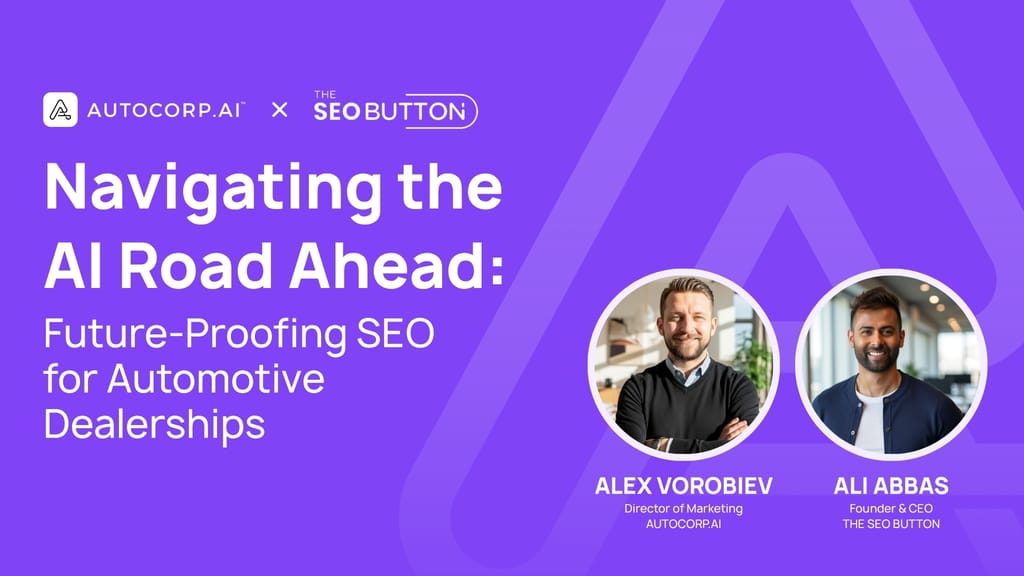
The SEO landscape is evolving faster than ever, driven by the rise of AI-powered search tools. For automotive dealerships, that shift is both a challenge and an opportunity. During Autocorp.ai’s latest webinar, Navigating the AI Road Ahead: Future-Proofing SEO for Automotive Dealerships, Ali Abbas, CEO of The SEO Button, joined Alex Vorobiev, Director of Marketing at Autocorp.ai, to unpack how dealerships can stay visible, competitive, and profitable in this new era of search.
Ali shared insights into how AI is reshaping search behaviour, what that means for traditional SEO, and practical steps dealerships can take today to optimize for both Google search and AI-driven engines like ChatGPT and Perplexity.
Here’s a detailed recap of what was covered.
Key Takeaways
- SEO still matters, but behavior is shifting to AI answers, impressions are up and CTR is down from about 2% to 0.2%.
- Google remains dominant, about 95% of Americans still use it, and roughly 60% of links overlap between Google and AI results.
- Win on fundamentals, focus on keyword research, quality backlinks, and local SEO signals like reviews, citations, and consistent NAP.
- Structure content for AI, add machine-readable pages, validate schema, and use tools like Brand Brain, Info Page Generator, and Schema Markup Generator.
- Expand beyond Google, use YouTube, Wikipedia, and Reddit to earn mentions that AI engines pull into answers, then track with Semrush, Ahrefs, Profound, or Peak AI.
SEO Isn’t Dead, It’s Evolving
One of the biggest myths circulating right now is that “SEO is dead.” According to Ali, this misconception surfaces every few years, usually following major Google algorithm updates. The reality? SEO is not disappearing, it’s evolving.
Ali pointed out that Google has been using AI for years, and while AI-powered search results are changing how people interact with information, they aren’t eliminating the need for websites. In fact, impressions in search results are rising, but click-through rates have dropped dramatically, from around 2% to just 0.2%.
That decline isn’t because users have stopped searching. Traditional Google usage is down only about 1%. Instead, AI tools are increasing the total number of searches, offering direct answers that often remove the need to click through to websites.
The key takeaway: Visibility still matters. Being mentioned by AI search engines is becoming just as valuable as earning clicks in Google results.
Traditional Search Still Dominates
While AI search is growing, traditional Google search remains dominant, with roughly 95% of Americans still using it regularly. Ali emphasized that dealerships can’t afford to abandon SEO fundamentals.
The overlap between traditional and AI search results is significant, roughly 60% of links appear in both. That means ranking well on Google continues to improve your presence across AI systems, too.
In short: the same strong SEO strategy that helps you rank in Google also increases your visibility when AI engines pull information to generate responses.
The Evolution of SEO in the AI Era
Ali outlined four major eras of SEO:
- Keyword-focused (1980s–2000s) – Ranking based on keyword density.
- Backlink era – Building authority through external site references.
- User signals era – Google introduced AI to prioritize engagement metrics like dwell time and relevance.
- AI-driven era (today) – Search optimization now includes LLMs (Large Language Models) and conversational AI systems.
Despite the changes, the principles of keyword research, authority building, and high-quality content creation remain central. What’s different is how that content needs to be structured and shared.
Keyword Research and Content Strategy for Dealerships
For automotive dealerships, keyword research remains the foundation of visibility. Ali recommended identifying competitor keywords and filtering them down to uncover high-value opportunities.
These keywords should then be integrated into your homepage, service pages, product or car detail pages, and blog posts. Long-form content is especially effective for addressing specific customer questions like:
- “How much does it cost to finance a Toyota RAV4?”
- “What are the best used car dealerships in Toronto?”
Ali also encouraged creating comparison listicles, articles such as “Best Dealerships in [City]” or “Top SUVs for Winter Driving.” These pieces consistently perform well in both traditional and AI search results and should represent about 25–50% of your content strategy.
Building Authority Through Quality Backlinks
Backlinks remain Google’s primary differentiator when determining which sites to rank highest. A backlink, another site linking to yours, is like a vote of confidence.
However, quality outweighs quantity. Ali noted that most top-ranking pages have at least 100 referring domains, showing strong industry trust.
There are two main approaches to acquiring backlinks:
- Link earning, which happens naturally when people reference your content.
- Link building, which involves proactively reaching out to request links.
To enhance topical authority, dealerships should produce related content around specific models or services (for example, “Honda Civic Maintenance Guide”) and use internal linking to connect those pages. This builds a web of expertise that Google and AI engines recognize as authoritative.
Local SEO: The Cornerstone for Dealership Visibility
For local businesses like dealerships, local SEO is critical. Ali outlined three primary ranking factors:
- Reviews – Authentic customer reviews boost credibility and visibility.
- Citations – Mentions of your business across directories like Yelp or YellowPages.
- Local signals – Consistency in your business name, phone number, and address (NAP).
Ali recommended BrightLocal as a research and citation management tool. Ensuring identical business information across directories helps search engines trust your business data, improving your placement in Google Maps and AI-driven local searches.
Enter the AI Search Era: Understanding What AI Knows About You
In AI-driven search, platforms like ChatGPT, Claude, and Perplexity now research for the user and display summarized results from multiple sources. That means your dealership’s visibility depends on whether these AI systems recognize and understand your brand.
Ali demonstrated how to use Brand Brain, a tool that reveals what AI models currently know about your company. By entering your business name or URL, you can see how AI engines represent your brand and identify areas where your information may be incomplete or inaccurate.
See how 650+ dealerships use AVA® to surface credit-qualified buyers before they sit down at the desk.
This brand analysis is the first step in AI search optimization, you can’t improve your AI presence without understanding your current representation.
Technical Implementation: Making Your Website AI-Friendly
Once you understand your AI search profile, it’s time to make your website easier for large language models (LLMs) to interpret.
Ali introduced two powerful tools for this purpose:
- Info Page Generator – This tool helps create machine-readable pages that summarize key details about your dealership for AI systems.
- Schema Markup Generator GPT – This helps you create and validate schema code, allowing search engines to better understand your website’s content structure.
He also mentioned the LLM Page Generator from SEO Notebook, which formats your site data in ways that large language models can easily interpret. This makes it more likely that your dealership will be referenced accurately in AI-generated answers.
Ali cautioned that schema markup often requires several iterations and validation tests to ensure accuracy before publishing. Many dealerships can implement schema through WordPress plugins or with support from web developers.
Beyond Google: Expanding Visibility on Other Platforms
Ali emphasized that the AI search ecosystem goes beyond Google. Several platforms currently influence both AI and traditional search visibility:
- YouTube – Performs exceptionally well across both search types. Creating short, high-quality videos (vehicle walkarounds, service tips, financing advice) can significantly expand reach.
- Wikipedia – Useful for multi-location dealerships that want to establish broad authority, as AI tools often reference Wikipedia entries.
- Reddit – A major data source for AI platforms. Engaging in relevant automotive discussions or partnering with Reddit marketing services can help ensure your brand is part of these conversations.
Tracking SEO and AI Search Performance
While traditional SEO has clear metrics and tools like Semrush and Ahrefs, AI search is still in its early stages of measurement.
Ali mentioned several emerging tools, including Profound and Peak AI, that provide insights into how your brand appears across AI platforms. These allow you to track rankings, compare competitors, and monitor your performance over time.
For smaller dealerships, Ali recommended manual testing, simply input your brand and keywords into ChatGPT, Claude, or Perplexity to see how your dealership appears.
AI SEO Checklist for Dealerships
Get your hands on the ultimate on-page SEO + AEO checklist built specifically for dealerships. This step-by-step guide helps your team optimize for both traditional search and emerging AI-driven answer engines. From local keyword targeting to schema markup, this resource ensures your site stays visible and competitive in 2026.
Download the Complete Slide Deck
Missed the live session or want to revisit the strategies discussed? Download the full slide deck from Navigating the AI Road Ahead: Future-Proofing SEO for Automotive Dealerships. It’s packed with data-driven insights, practical takeaways, and real examples shared by Alex Vorobiev and Ali Abbas.
Watch the Full Webinar Recap
Couldn’t make it to the live event? Catch the full replay to see how Alex and Ali break down the future of search, AI integration, and dealership marketing. Learn the exact SEO strategies that are already helping dealers rank higher, attract organic leads, and stay ahead of Google’s AI updates.
Frequently Asked Questions About AI SEO for Automotive Dealerships
Is SEO still relevant with AI-driven search?
Yes. AI is changing how people get answers, but SEO is still the base. Impressions are rising while clicks are thinning, so visibility and mentions now carry more weight. Keep your SEO fundamentals tight, then optimize for AI answer engines as a second layer.
What content should dealerships create to perform in both Google and AI answers?
Prioritize long-form posts that answer specific buyer questions, model and service pages, and comparison listicles. Include “Best Dealerships in [City]” and “Top [Vehicle Type] for [Use Case]” articles. Aim for 25 to 50 percent of your plan to be comparison content that earns links and gets cited by AI.
What are the most important local SEO factors for dealerships?
Focus on reviews, citations, and consistent NAP across directories. Use a tool like BrightLocal to audit and fix listings. This improves Google Maps rankings and helps AI systems trust and quote your business data.
How can I see what AI models know about my dealership today?
Use Brand Brain to check how your brand appears in AI systems. Enter your name or URL, review the summary, and note any gaps or errors. This audit guides your updates across your site, profiles, and structured data.
How do I make my site easier for LLMs to understand and cite?
Create machine-readable info pages and add accurate schema. Use Info Page Generator and Schema Markup Generator to produce and validate markup. Expect to test and refine the schema before
The Road Ahead
The webinar closed with a key message: AI isn’t replacing SEO, it’s reshaping it.
Dealerships that embrace both traditional and AI-focused optimization will maintain stronger visibility, attract higher-quality traffic, and stay competitive as search evolves.
By leveraging the right tools like BrightLocal for local SEO, Brand Brain and Info Page Generator for AI analysis, and Schema Markup Generator for technical optimization, dealerships can future-proof their digital presence and continue converting organic traffic into customers.